
Monitoring backlinks remains a core task in search engine optimisation (SEO). Inbound links signal trust and influence search rankings, so losing high‑quality links can hurt SEO and marketing efforts.
Conversely, gaining backlinks from poor‑quality or spammy sites can damage your reputation. Modern backlink monitoring tools help agencies and website owners track new, lost, and broken links and spot competitor link‑building strategies.
When evaluating tools for 2026, I looked at database size and refresh rate, alert and reporting capabilities, quality metrics (domain authority, spam scores), scalability for agencies, and competitor analysis features. Below are five trusted tools (ranging from free to enterprise‑grade) along with their strengths, limitations, and pricing.
TL;DR
- Monitoring backlinks helps protect SEO performance by alerting you to newly acquired links, lost links, and potentially harmful links that could trigger a penalty. Proactively managing your backlink profile ensures you capitalize on good links and disavow bad ones.
- SAASY LINKS’ Free Backlink Checker – Monitor whether your backlinks are still live and verify if they remain dofollow or have been changed to nofollow or sponsored. Manually enter a link or paste from Google Sheets, Excel, or Airtable to autofill multiple rows instantly. No login/signup required.
- Ahrefs – A premium platform powered by the world’s second-most active crawler that continuously indexes the web. Plans start at $129/month and scale up to $1,499/month for enterprise. It offers detailed backlink metrics, new & lost backlink alerts, and competitor analysis. Ideal for agencies and large teams that need a massive, frequently updated index; the high cost may be overkill for small sites.
- Semrush – Semrush’s Backlink Analytics taps into a database of 43 trillion links across 390 million domains. Its free backlink checker shows the top 25 backlinks with Authority Score, link attributes, and whether links are new or lost. The paid “Semrush One” plans ($165–$456/month) add AI-powered keyword tracking and competitive analysis. The breadth of features and data comes with a steep learning curve and a higher price tag.
- SE Ranking – lets you import backlinks from Google Search Console or manually add your own. The crawler runs periodic checks and emails you when a backlink changes, disappears, or becomes nofollow. Proprietary Domain Trust and Page Trust metrics help evaluate link quality. Plans range from $65 to $259/mont,h depending on the number of backlinks monitored, making it suitable for growing businesses that need a balanced mix of features and affordability.
- Linkody – A user-friendly tool that monitors backlinks 24/7 and notifies you when links are gained or lost. It shows Moz Domain Authority, Spam Score and whether links are indexed in Google; a visualiser pinpoints the link’s location on the page. Pricing starts at $14.90/month for two domains and 500 links, scaling up to $153.90/month for agency needs. Ideal for small agencies and site owners who want automatic alerts without complex dashboards.
- Google Search Console – A free tool that provides a Links report listing top‑linked pages on your site and the domains that link to you. The report groups duplicate links and is limited to 1,000 rows, so it functions more as a high‑level snapshot than a comprehensive monitoring system. Use it alongside a dedicated backlink tool for deeper analysis.
Comparison Table
| Tool | Unique strengths | Pricing (approx.) | Key limitations |
|---|---|---|---|
| Ahrefs | Massive backlink index; new & lost link alerts; full SEO suite | Lite: US$129/mo, Standard: US$249/mo, Advanced: US$449/mo, Enterprise: US$1 499/mo | High cost; steep learning curve |
| Semrush | Industry‑leading database (43 trillion links); continuous updates and AI visibility features | Starter: ~US$165.17/mo (annual), Pro+: ~US$248.17/mo, Advanced: ~US$455.67/mo | Interface can be overwhelming; more expensive than specialist tools |
| SE Ranking | Manual or GSC import, regular checks and email alerts; metrics like Domain Trust & Page Trust; disavow file generation | Essential: US$65/mo (17.5 k backlinks), Pro: US$119/mo (30 k+), Business: US$259/mo (90 k+) | Requires manual setup/import; fewer integrations |
| Linkody | Dedicated backlink monitoring; simple UI; competitor tracking with Moz metrics | Plans from US$14.90/mo to US$153.90/mo (Pro plan ~US$49.90/mo) | Limited to backlink monitoring; smaller index than multi‑suite tools |
| Google Search Console | Only a sample of backlinks (limited to 1,000 rows); no competitor data or quality metrics | Free | Only a sample of backlinks (limited to 1 000 rows); no competitor data or quality metrics |
Table of Contents
Why Backlink Monitoring Matters More Than Ever
Backlinks remain one of the strongest signals of authority on the web. But earning links is only half the battle — keeping them is just as important. High-quality backlinks can disappear, change attributes, or get buried on pages that lose visibility. Without active monitoring, you may not realize you’re losing valuable SEO equity until rankings begin to drop.
Modern backlink monitoring tools solve this by tracking new and lost links in real time. They help teams protect their most important link placements, detect harmful links early, and understand how their off-page SEO strategy evolves over time.
How Backlink Monitoring Supports SEO and AI Visibility
Search engines and AI systems both rely on consistent external signals to assess credibility. When authoritative sites repeatedly reference your brand, these brand mentions reinforce trust and increase your chances of appearing in search results and AI-generated answers.
Backlink monitoring software ensures those signals remain stable. By quickly identifying lost links or suspicious patterns, you can preserve the trust your site has built across the web. In an era where AI search is growing rapidly, maintaining a strong and consistent backlink profile is essential for long-term visibility.
What to Look for in a Backlink Monitoring Tool
Not all backlink tools are built the same. The best platforms combine accurate link tracking, change alerts, and quality metrics with easy reporting. Features like real-time notifications, spam detection, competitor tracking, and historical link data allow teams to move from reactive monitoring to a proactive strategy.
Choosing the right tool depends on your goals. Agencies may prioritize reporting and multi-client management, while individual site owners may focus on affordability and simplicity. Understanding what matters most helps you select a platform that fits your workflow.
Best Backlink Monitoring Tools
Bonus Tool by SAASY LINKS
Monitor whether your backlinks are still live and verify if they remain dofollow or have been changed to nofollow or sponsored.
Manually enter a link or paste from Google Sheets, Excel, or Airtable to autofill multiple rows instantly.
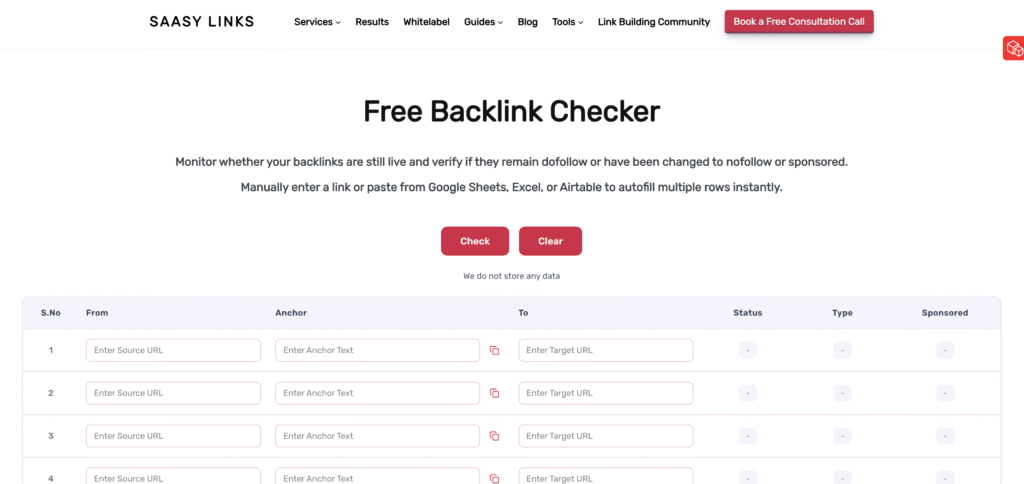
We do not store any data. No login/signup required.
1. Ahrefs
Ahrefs is one of the most widely used SEO platforms. According to its pricing page, the company operates “the world’s second‑most active crawler” with more than a decade of web‑scale data.
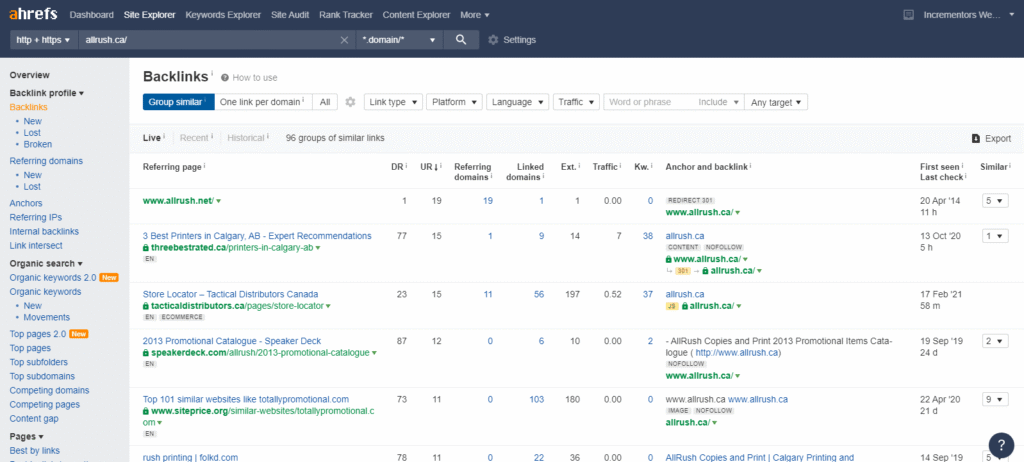
Its Alerts feature lets you set up notifications for any website; you get an email whenever that site gains or loses backlinks.
Key features:
- Large backlink index: Ahrefs reports that it collects massive web data through its active crawler. Its Site Explorer provides granular reports for new and lost backlinks and lets you filter by anchor text, domain ratings, and follow/nofollow attributes.
- New & lost link alerts: Ahrefs’ Alerts tool sends notifications whenever a monitored domain gains or loses backlinks. This allows marketers to respond quickly to link removals or competitor link acquisition.
- Comprehensive suite: Besides backlink monitoring, Ahrefs includes Site Audit, Keywords Explorer, Rank Tracker, and Brand Radar, making it a full‑stack SEO platform.
Pricing:
- The Lite plan starts at US $129 per month (when paid monthly) and includes one user, 5 projects, and 100,000 crawl credits.
- The Standard plan is US $249 per month
- The Advanced plan is US $449 per month
- The Enterprise plan costs US $1499 per month (annual commitment).
- Prices can vary depending on billing frequency and optional add‑ons.
Pros:
- Very large and frequently updated link database
- Custom alerts for new and lost links
- Comprehensive SEO toolkit (rank tracking, keyword research, competitor analysis)
Cons:
- High price and seat restrictions for agencies
- Steeper learning curve compared with simpler tools
2. Semrush
Semrush offers an all‑in‑one SEO, AI, and marketing suite. Its Backlink Analytics uses a massive database of 43 trillion links from 390 million domains and updates continuously.
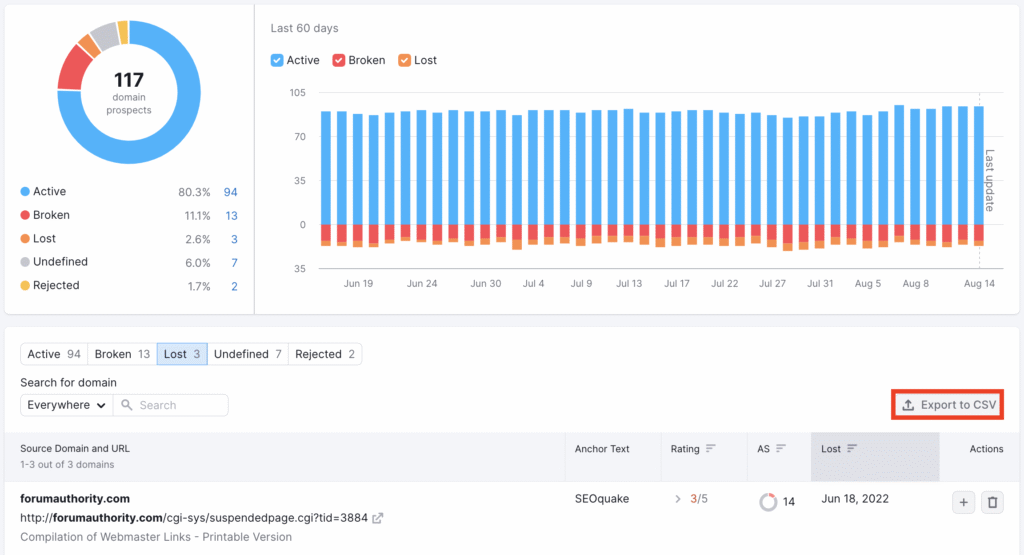
The platform’s free backlink checker provides top 25 backlinks plus metrics such as Authority Score, referring domains, and link status tags that indicate whether a backlink is newly discovered or recently lost.
Key features:
- Largest backlink database: Semrush claims its crawler scans billions of pages and maintains a database of 43 trillion links. The data includes link attributes (dofollow/nofollow) and link status tags for newly discovered or lost backlinks.
- Competitor insights: Backlink Analytics helps identify sites linking to competitors but not to you, highlight content types that earn links, and recover lost backlinks.
- All‑in‑one suite: Beyond link monitoring, Semrush offers keyword research, rank tracking, content marketing tools, and AI‑powered analytics.
Pricing: Semrush introduced Semrush One, which blends traditional SEO with AI‑visibility tracking.
- The Starter plan costs about US $165.17 per month when billed annually (regularly US$199/month) and includes the AI visibility toolkit, monitoring for up to 5 websites, and 50 daily AI prompts.
- The Pro+ plan is roughly US $248.17 per month when billed annually (regular price US $299) and supports up to 15 websites.
- The Advanced plan offers API access and automation for about US $455.67 per month when billed annually (US $549 monthly).
Pros:
- Industry‑leading backlink database and continuous updates
- Offers AI‑visibility tracking and numerous SEO/marketing features
- Good for competitor analysis and outreach planning
Cons:
- Pricing is higher than specialised link‑monitoring tools
- The interface can be overwhelming for new users
3. SE Ranking Backlink Monitoring
SE Ranking is an all‑in‑one SEO platform popular with small businesses and agencies. Its Backlink Tracking Tool monitors existing backlinks and provides alerts when status changes.
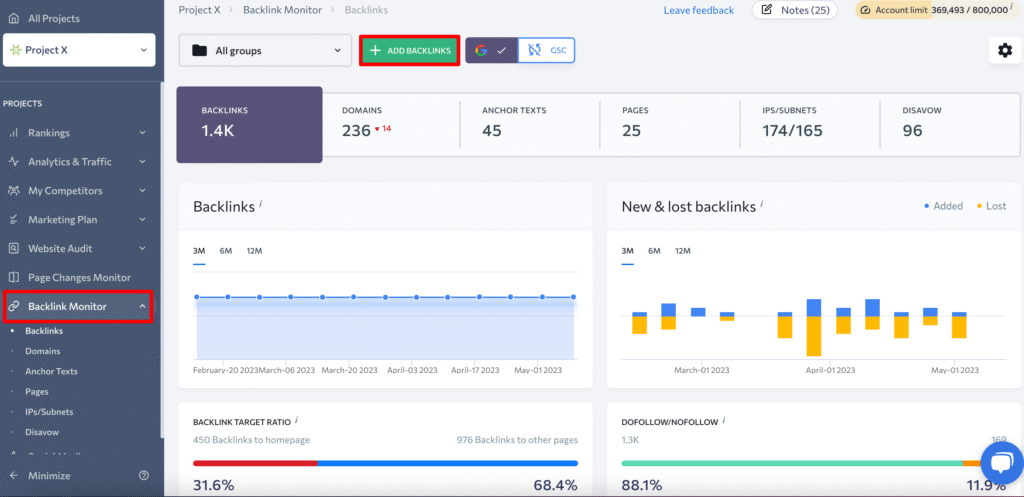
Users can manually add backlinks or import them from Google Search Console or SE Ranking’s Backlink Checker. The system runs regular parameter checks using its crawler and sends email notifications when backlinks change.
Key features:
- Regular checks and alerts: After adding backlinks, SE Ranking’s crawler performs periodic checks and sends email alerts if a backlink is removed, becomes a 404, or changes to nofollow.
- Status and value analysis: The tool indicates whether backlinks are found/not found, indexed/not indexed, and displays first‑seen/last‑seen dates. It also assesses link quality through metrics like Domain Trust and Page Trust, along with dofollow/nofollow attributes.
- Visual dashboards: Charts summarise backlink growth dynamics, ratio of homepage vs. deep‑page links, and distribution of referring domains by country.
- Disavow file generation: The platform lets you mark spam backlinks and generate a Google disavow file.
Pricing: SE Ranking offers tiered pricing based on backlink volume.
- The Essential plan is US $65 per month and covers up to 17,500 backlinks and 5 projects.
- The Pro plan starts from US $119 per month (about 30,000 backlinks)
- The Business plan starts from US $259 per month for larger backlink limits and API access. A free trial is available.
Pros:
- Affordable and scalable pricing for different backlink volumes
- Email alerts for changes and a built‑in disavow feature
- Additional metrics like Domain Trust and Page Trust help assess link quality
Cons:
- Requires manual import or initial data from GSC or SE Ranking’s backlink checker
- Fewer third‑party integrations compared with Ahrefs or Semrush
4. Linkody
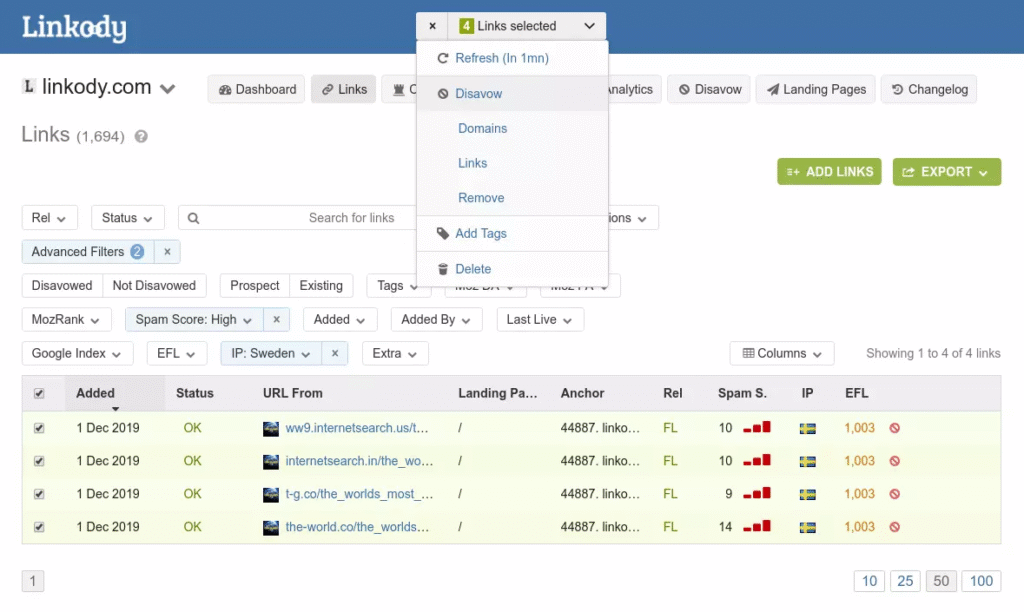
Linkody is a dedicated backlink monitoring tool aimed at freelancers and small agencies. Its homepage lists key features: 24/7 backlink monitoring, analysis of link profiles with key metrics, competitor strategy discovery, and the ability to disavow harmful links.
Key features:
- Continuous link monitoring: Linkody’s crawler watches backlinks around the clock and alerts users when links change.
- Metric analysis: The platform analyses link profiles using metrics such as domain authority and spam score (powered by Moz metrics) to help assess link quality.
- Competitor tracking: Users can explore competitors’ backlinks to understand their link‑building strategies and identify outreach targets.
- Disavow support: The tool helps users identify toxic links and generate disavow files.
Pricing:
- Linkody offers an entry price of US $14.90 per month and a high price of US $153.90 per month, with five available plans.
- The Pro plan (recommended for agencies) costs around US$49.90 per month according to independent reviews (pricing details vary by plan size).
Pros:
- Simple interface suitable for beginners
- Daily crawls and email alerts
- Competitor backlink monitoring using Moz metrics
- White‑label reporting for agencies
Cons:
- Focuses only on backlink monitoring; lacks rank tracking or keyword research
- Smaller index than Ahrefs or Semrush; may miss some backlinks
5. Google Search Console (Links Report)
Google’s Search Console (GSC) provides a Links report that shows external sites linking to your site and your most linked pages.
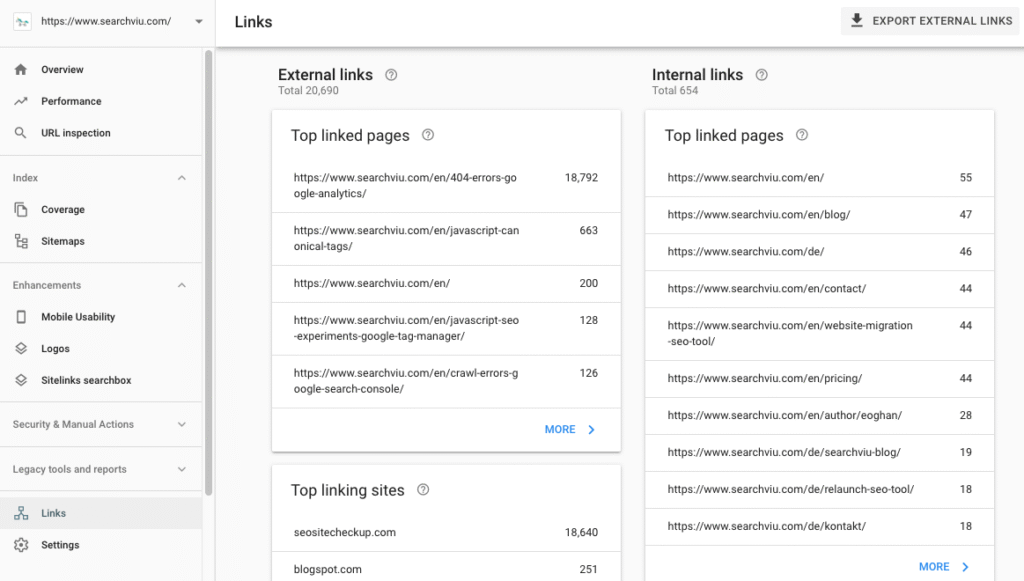
Because the data comes directly from Google’s index, it is highly accurate; however, the report is a sample rather than a complete list—tables are limited to 1 000 rows, duplicate links are combined, and some URLs may be omitted.
Key features:
- Top linked pages and top linking sites: The report lists pages on your site that receive the most backlinks and the domains that link to you most often.
- Link text and domain grouping: It shows the most common anchor text and groups domains by root domain (e.g., example.com and m.example.com are combined).
Pros:
- Accurate backlink data directly from Google’s index
- Completely free for website owners
Cons:
- Only provides a sample of backlinks; tables are limited to 1000 rows, and duplicates are combined
- Lacks quality metrics (domain authority, spam score) and competitor analysis features
- Requires site verification; cannot view competitors’ links
Pricing: GSC is free. You simply verify ownership of your site to access the Links report.
Conclusion
The best backlink monitoring tool depends on your budget and needs.
Ahrefs and Semrush provide the most comprehensive data and competitor insights, but come at a higher cost.
SE Ranking offers a strong balance of features and affordability, while Linkody is a simple, budget-friendly option for basic monitoring.
Google Search Console is a good free starting point, though limited for deeper analysis.
FAQs
What is a backlink monitoring tool?
A backlink monitoring tool tracks links pointing to your website and alerts you when links are gained, lost, or changed. It helps protect your SEO authority, detect harmful links, and measure the impact of link building campaigns.
Why is backlink monitoring important for SEO and AI search visibility?
Backlink monitoring protects the trust signals that influence rankings and AI citations. Losing high-quality links or gaining spammy ones can reduce your site’s credibility and visibility in both Google search and AI-generated answers.
How often should I monitor backlinks?
Weekly monitoring is sufficient for most websites, but active campaigns should use daily alerts. High-value pages and recent placements benefit from real-time monitoring to quickly recover lost links.
Which backlink monitoring tool is best for agencies?
Agencies benefit most from tools that offer multi-project tracking, automated alerts, and client reporting. SE Ranking and Linkody are strong for workflow management, while Ahrefs and Semrush are better for deep competitive research.
Which tool is best for recovering lost backlinks?
Tools with fast lost-link alerts and clear history tracking work best. Ahrefs and Linkody are widely used for quick detection and link reclamation campaigns.
Can Google Search Console replace a backlink monitoring tool?
No. Google Search Console provides a high-level snapshot of backlinks but does not offer comprehensive alerts, detailed link quality metrics, or campaign-level monitoring.
What is a good monthly backlink monitoring workflow?
Review new and lost links, reclaim valuable losses, audit link quality trends, flag suspicious domains, update disavow decisions if needed, and report outcomes.
Which backlink monitoring tool is best on a budget?
Linkody is a strong budget-friendly option focused on alerts and monitoring. SE Ranking is another good value choice if you want monitoring plus broader SEO features.
How do I choose the right backlink monitoring tool?
Choose based on your priority: simple monitoring (Linkody), agency workflows (SE Ranking), deep research (Ahrefs), or all-in-one SEO platforms (Semrush). Consider index freshness, reporting features, and scalability.
