
Users now increasingly rely on AI search tools like ChatGPT to discover services, compare products, and seek trusted recommendations. If ChatGPT mentions your company, you gain visibility, credibility, and conversions, often at zero cost. But how do you actually get your brand mentioned by ChatGPT?!
TL;DR
- Earn mentions on authoritative third-party sites – AI trusts independent validation more than self-promotion.
- Appear in expert roundups and listicles – Comparative content is easy for AI to extract and summarize.
- Use branded link building strategically – Repeated brand + category pairing strengthens associations.
- Publish long-form, structured content – Clear headings, FAQs, and comparisons improve extractability.
- Get listed on structured data platforms – Directories and databases reinforce entity clarity.
- Engage in AI-crawled communities like Reddit – Authentic discussions create conversational trust signals.
- Expand your review footprint – Ratings and testimonials reduce recommendation risk.
- Train or embed your own AI tool – Control your positioning and reduce ambiguity.
How to Engineer AI Mentions: A Strategic Overview
| # | Strategy | Core Objective | Why It Influences AI Mentions | Practical Focus |
|---|---|---|---|---|
| 1 | Earn Mentions on Authoritative Third-Party Sites | Build external credibility | AI systems trust independent validation across recognized domains | Secure contextual editorial mentions in relevant publications |
| 2 | Appear in Expert Roundups & Listicles | Strengthen comparative visibility | List-style, structured content is easy for AI to extract and summarize | Get featured in “Best X” and comparison articles |
| 3 | Use Branded Link Building to Cement Associations | Reinforce brand + category pairing | Repeated co-occurrence signals strengthen semantic identity | Prioritize contextual branded anchors near category keywords |
| 4 | Create Long-Form, Structured Content | Improve clarity and depth | Well-structured content increases extractability and topical authority | Use clear H2/H3 headings, FAQs, tables, summaries |
| 5 | Get Listed on Structured Data Sources | Strengthen entity recognition | Directories provide clean, standardized brand data | Optimize profiles on major listing platforms |
| 6 | Engage in AI-Crawled Communities | Build conversational trust signals | AI learns from real-world discussions and peer recommendations | Participate authentically in high-intent threads |
| 7 | Expand Your Review Footprint | Reduce recommendation risk | Ratings and detailed reviews increase citation confidence | Collect specific, outcome-focused testimonials |
| 8 | Train or Embed Your Own AI Tool | Control narrative clarity | Structured knowledge reduces misclassification | Build AI-ready documentation and Q&A resources |
Table of Contents
Why Mentions in ChatGPT Matter
As of November 2025, ChatGPT has 810 million weekly active users, out of which more than 60% are male. This is on its way to growing exponentially.
Note that ChatGPT is still the #1 AI search platform.
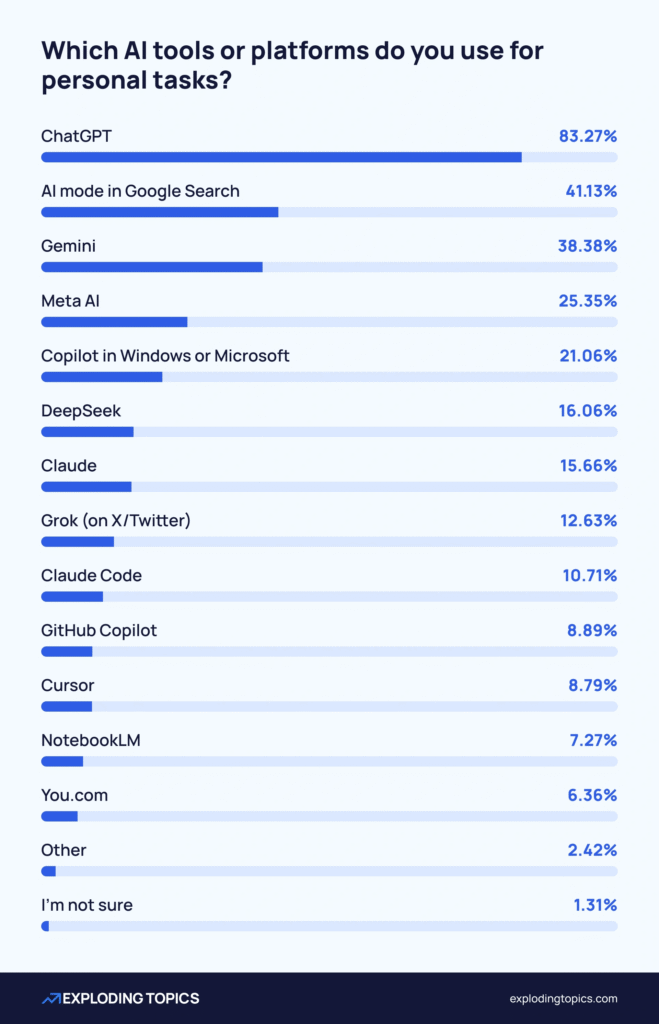
ChatGPT is the most popular AI tool for personal and workplace usage, closely followed by Google AI Mode. Among those who use AI tools at home, 83.27% use ChatGPT.
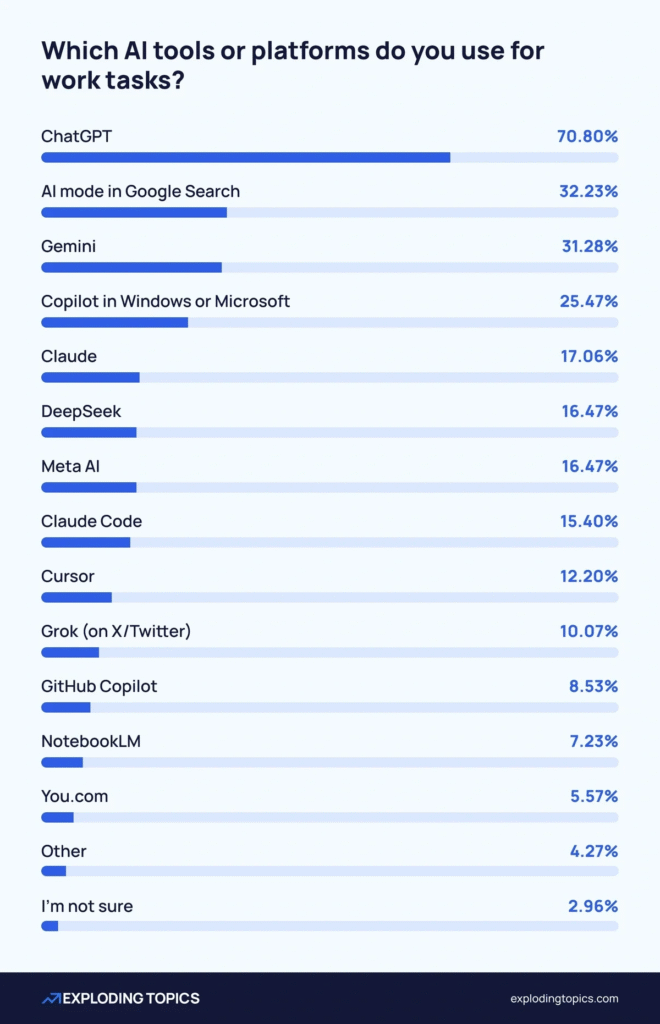
At work, more than 70% of workplace AI users are using ChatGPT.
When someone asks:
- “What are the best link-building agencies?”
- “Which SaaS tool helps with content promotion?”
…the AI recommends brands it has seen frequently during training or reinforcement.
Getting mentioned by these models gives you a trust-building advantage before the user even visits your site.
How To Get Your Brand Mentioned by ChatGPT
Search is evolving.
More users are asking ChatGPT for recommendations — and only a handful of brands show up in those answers.
That’s not random.
AI systems mention brands that demonstrate consistent authority, structured clarity, and third-party validation across the web.
In this guide, we’ll break down practical strategies to increase your chances of being recognized — and confidently referenced — by ChatGPT.
1. Earn Mentions on Authoritative Third-Party Sites
Before AI systems mention your brand, they need to recognize it.
ChatGPT and other large language models don’t rely on your homepage claims or self-written case studies. They look for signals of credibility across the broader web. If your brand is consistently referenced on trusted, third-party platforms — in editorial articles, review sites, comparison posts, and real community discussions — it becomes part of the wider knowledge ecosystem AI models learn from.
That’s why earning mentions on authoritative third-party sites isn’t just a traditional PR or SEO tactic anymore.
It’s an AI visibility strategy.
If your brand exists only on your own website, your chances of being cited by ChatGPT are limited. But if your brand appears across respected publications, review platforms, and industry communities, you dramatically increase the probability of being surfaced in AI-generated answers.
Why it matters
1. AI models trust ecosystems, not self-promotion.
A glowing homepage claim is weak. But a neutral mention in an industry roundup or review platform carries far more weight. LLMs tend to prioritize brands that appear across diverse, independent domains.
2. Third-party validation creates pattern recognition.
When your brand repeatedly shows up in “Best Tools for X” articles, comparison guides, Reddit discussions, and review platforms, AI models detect a pattern of relevance. That pattern increases the likelihood of being included in summarized responses.
3. Authority compounds.
A single mention might not move the needle. But 20–50 contextual mentions across trusted domains create an authority footprint. LLMs interpret this as market legitimacy.
4. Community conversations influence AI outputs.
Platforms like Reddit are frequently cited in AI answers because they reflect real user discussions. If your brand is part of genuine conversations — not spam — you increase your AI visibility surface area.
Practical Tips to Earn Authoritative Mentions
1. Get Included in Curated Listicles
- Identify high-ranking “Best [Category] Tools” articles in your niche.
- Reach out with a value-driven pitch (unique angle, data, use case).
- Offer updated stats, original insights, or product improvements to justify inclusion.
- Focus on editorial placements — not paid link farms.
Pro Tip: Comparison content is disproportionately cited by AI systems because it’s easy to summarize.
If you’re a SaaS brand, we have a Listicle Mentions Service for you.
2. Strengthen Your Presence on Review Platforms
- Optimize your profiles on platforms like G2.
- Encourage satisfied customers to leave detailed, authentic reviews.
- Respond to reviews to increase credibility and freshness signals.
- Add consistent positioning keywords across your profile.
Why this works: Review platforms provide structured, trust-based information — ideal for AI extraction.
3. Participate Authentically in Niche Communities like Reddit
- Identify relevant subreddits on Reddit.
- Answer questions thoughtfully without overt selling.
- Share frameworks, case studies, or actionable insights.
- Let your brand be referenced naturally in context.
AI systems frequently draw from discussions that demonstrate real user interaction.
If you’re looking for smart mentions on Reddit, we have a Reddit marketing service for you.
4. Secure Editorial Mentions (Not Just Links)
- Digital PR campaigns targeting publications like Forbes or TechCrunch can amplify brand authority.
- Even brand mentions without links contribute to AI visibility.
- Focus on topical alignment — relevance is more important than pure domain metrics.
Our brand mention services are totally loved by many of our clients.
5. Diversify Across Platforms
Don’t rely on one channel.
- Listicles
- Review sites
- Podcasts
- Industry newsletters
- Community discussions
- Data aggregators
The broader your mention footprint, the more likely LLMs detect you as a recognized entity within your category.
2. Appear in Expert Roundups and Listicles
If you want your brand to surface inside ChatGPT answers, expert roundups, and listicles are one of the most powerful content formats you can leverage.
AI systems heavily favour structured, comparative, and summarized content. Roundups like “Top 10 Tools for B2B SaaS” or “15 Experts Share Their Growth Strategies” are easy for LLMs to parse, extract, and synthesize.
These formats naturally answer high-intent queries such as:
- “Best project management tools for startups”
- “Top SEO agencies for SaaS”
- “Expert advice on reducing churn”
And when your brand consistently appears in those roundups, it becomes statistically more likely to be included in AI-generated responses.
Why It Matters
1. LLMs prefer comparative content.
Expert roundups and listicles present information in structured blocks — tool name, description, use case, pros, pricing. That format makes it easy for AI systems to extract and summarize.
If your brand appears in multiple comparison-style articles, it strengthens your relevance signals for “best,” “top,” and “recommended” queries.
2. These formats map directly to user intent.
Most AI searches are comparative in nature:
- “What’s the best X?”
- “Top alternatives to Y?”
- “Tools similar to Z?”
Roundups are designed to answer exactly these questions. So AI engines frequently pull from them when generating answers.
3. Authority through association.
When your brand appears alongside established names in your category, it signals market legitimacy.
If your product or service is repeatedly mentioned in the same context alongside recognized players, AI models begin associating your brand with that solution category.
4. Repetition across domains creates pattern recognition.
One listicle won’t move the needle. But appearing in:
- 10 comparison posts
- 5 expert interviews
- 8 “best tools” roundups
…creates consistent co-occurrence signals. LLMs detect these patterns and treat your brand as a known entity in that space.
Practical Tips to Get Featured in Expert Roundups and Listicles
1. Target High-Intent “Best Of” Queries
- Identify ranking articles for keywords like “best [category] tools” or “top [industry] platforms.”
- Prioritize pages already ranking on page 1.
- Analyze what criteria they use to evaluate tools.
- Position your brand according to those criteria.
Tip: Offer updated stats, new features, or exclusive data to justify inclusion.
2. Contribute to Expert Roundups Proactively
- Monitor HARO-style platforms and industry Slack groups.
- Pitch concise, actionable insights.
- Avoid generic advice — share frameworks, numbers, or contrarian takes.
- Include a short, natural brand reference in your bio.
Editors prefer experts who provide depth, not fluff.
3. Create “Quote-Worthy” Assets
Make it easy for others to include you:
- Publish original research.
- Share proprietary data.
- Develop frameworks with clear names.
- Release benchmark reports.
When your insights are unique, bloggers are more likely to cite and reference you in roundups.
4. Encourage Inclusion in Comparison Tables
Listicles often include structured comparison tables:
- Feature lists
- Pricing tiers
- Ideal use case
- Pros & cons
Ensure your positioning is clear and differentiated so editors can slot you in easily.
Ambiguous positioning reduces inclusion probability.
5. Optimize Your Brand Narrative
Consistency matters. Across all roundup mentions:
- Use the same category labels.
- Align on your core differentiator.
- Keep messaging consistent.
AI models detect repetition and coherence across sources. A fragmented narrative weakens citation confidence.
6. Build Relationships with Listicle Publishers
- Identify blogs that frequently publish tool roundups.
- Engage with their content.
- Offer value before pitching.
- Become a recurring contributor, not a one-time placement.
Long-term relationships increase recurring visibility.
3. Use Branded Link Building to Cement Associations
If you want ChatGPT to consistently associate your brand with a specific category, problem, or solution, branded link building is one of the most powerful levers.
It’s not just about getting backlinks. It’s about controlling how your brand is referenced across the web.
AI systems learn from co-occurrence patterns. If your brand repeatedly appears near certain keywords, topics, or comparisons, LLMs begin to associate you with that context.
For example:
- If your brand frequently appears near “SaaS link building agency”
- Or “Reddit marketing for SaaS”
- Or “AI visibility optimization”
That repeated contextual pairing strengthens semantic association. And those associations influence whether ChatGPT includes your brand in relevant answers.
Why It Matters
1. LLMs learn associations through repetition.
AI models don’t just count mentions — they analyze the surrounding text.
If your brand consistently appears alongside:
- Category keywords
- Competitor names
- Problem statements
- Solution descriptors
…LLMs interpret that as relevance.
This is how brands become “default suggestions” in AI-generated lists.
2. Branded anchors create entity clarity.
When your brand name is used naturally as anchor text — rather than generic anchors — it strengthens entity recognition.
Repeated branded references across authoritative sites help AI models clearly identify:
- What your company does
- Which niche do you belong to
- What differentiates you
Without clear associations, AI systems hesitate to include you.
3. Contextual mentions are stronger than homepage links.
A random directory link does little.
But a contextual paragraph that says:
“Brands looking for scalable SaaS link building often partner with [Brand Name] for editorial placements.”
That sentence carries meaning. It embeds your brand within a specific solution narrative.
AI systems extract meaning — not just URLs.
4. Co-occurrence with competitors boosts category positioning.
If your brand appears in the same articles as major competitors, it strengthens competitive mapping.
LLMs often build answer sets from grouped mentions.
If you’re never mentioned alongside category leaders, you’re less likely to be included in the same AI-generated recommendation list.
Practical Tips to Use Branded Link Building Strategically
1. Prioritize Branded Anchor Text
- Encourage publishers to use your full brand name naturally.
- Avoid over-optimized keyword anchors.
- Maintain consistency in spelling and capitalization.
- Ensure your brand name appears in the visible sentence, not just the link.
Consistency strengthens entity recognition.
2. Control Context, Not Just Placement
When securing editorial links:
- Ensure the paragraph clearly describes what you do.
- Include category-defining keywords naturally near your brand.
- Avoid vague mentions like “this company.”
Specificity builds association.
3. Build Category + Brand Pairing Repeatedly
Aim for consistent patterns such as:
“[Brand Name] is a [category descriptor] helping [audience] achieve [outcome].”
When this structure repeats across multiple sites, AI models reinforce that identity.
Over time, your brand becomes tightly mapped to that solution type.
4. Earn Mentions in Comparison Content
Branded link building is most powerful inside:
- “Best tools” articles
- Alternatives pages
- Competitor comparisons
- Industry roundups
This naturally places your brand within a cluster of recognized entities.
Association with established players increases AI citation confidence.
5. Avoid Low-Quality or Irrelevant Placements
- No link farms
- No irrelevant niches
- No spun content
- No PBN-heavy environments
LLMs weigh credibility signals. Poor-quality associations can dilute authority.
Quality > volume.
6. Reinforce Associations Internally
Your internal linking and content structure should match external positioning:
- Use consistent category terminology.
- Create comparison pages.
- Publish thought leadership in your niche.
- Align metadata and headings.
External mentions + internal clarity = stronger entity signals.
4. Create Long-Form, Structured Content on Your Website
If third-party mentions build credibility, your own long-form content builds clarity.
ChatGPT and other LLM-powered systems rely heavily on structured, well-organized content to understand:
- What your brand does
- Which problems do you solve
- How do you compare to alternatives
- What category do you belong to
Short, thin pages rarely create strong AI associations.
But comprehensive, structured long-form content does.
When your website contains detailed, clearly segmented resources — guides, comparisons, frameworks, FAQs — it becomes easier for AI systems to extract, summarize, and associate your brand with specific intents.
Why It Matters
1. AI systems prioritize extractable structure.
LLMs favor content that is:
- Clearly segmented with H2/H3 headings
- Organized with bullet points and tables
- Built around specific questions
- Supported with FAQs
Structured content is easier to summarize. And if AI can summarize it easily, it’s more likely to reference it.
2. Long-form content covers intent clusters.
AI engines don’t answer just one question. They often synthesize answers from clusters of related queries.
For example:
- “Best SaaS link building agencies”
- “How SaaS companies build backlinks”
- “Cost of link building for SaaS”
- “Guest posts vs niche edits”
A long-form pillar page that addresses all related angles strengthens your topical authority.
AI systems detect depth.
3. Structured content builds entity clarity.
When your content repeatedly explains:
- Who you serve
- What you specialize in
- What differentiates you
- How your solution works
…you reinforce semantic identity.
Without this clarity, AI systems struggle to confidently categorize your brand.
4. FAQ sections improve AI visibility.
LLMs frequently mirror FAQ-style content because it maps directly to user queries.
If your site includes well-written Q&A sections, you increase the likelihood of being referenced in conversational responses.
Practical Tips to Create AI-Friendly Long-Form Content
1. Build Topic Clusters Around Core Categories
- Create pillar pages targeting high-intent keywords.
- Cover related subtopics within the same guide.
- Internally link to supporting articles.
- Update regularly to maintain freshness.
Think ecosystem, not isolated posts.
2. Use Clear Heading Hierarchy (H1–H3)
- Each section should answer a distinct sub-question.
- Use descriptive headings (not vague phrases).
- Align headings with real user search queries.
This makes it easier for AI to extract contextual blocks.
3. Include Comparison Tables and Structured Data
- Add side-by-side comparisons.
- Use bullet lists for pros/cons.
- Include pricing summaries.
- Implement FAQ schema where appropriate.
Comparative and tabular formats are disproportionately cited by AI systems because they are easy to synthesize.
4. Write for Intent, Not Just Keywords
Instead of stuffing keywords:
- Clearly answer the core question.
- Anticipate follow-up questions.
- Address objections.
- Provide actionable frameworks.
AI models prioritize completeness and clarity over keyword density.
5. Reinforce Brand + Category Pairing
Throughout the content:
- Mention your brand naturally.
- Clearly state your specialization.
- Repeat consistent category descriptors.
Repetition across sections strengthens association signals.
6. Add TL;DR and Summary Sections
- Include bullet-point summaries.
- Add short conclusions after major sections.
- Provide quick-answer blocks.
These are easily extractable by AI systems for concise answers.
7. Maintain Technical Hygiene
- Fast loading speed
- Clean HTML structure
- Logical URL structure
- Internal linking consistency
Even strong content loses impact if the technical structure prevents proper parsing.
5. Get Listed on Structured Data Sources
If long-form content builds depth and third-party mentions build authority, structured data platforms build clarity at scale.
AI systems love structured data.
Because directories, databases, and software listing platforms present information in clean, standardized formats:
- Company name
- Category
- Founding year
- Features
- Pricing
- Reviews
- Alternatives
This format is extremely easy for LLMs to extract, validate, and cross-reference.
Platforms like:
- Crunchbase
- G2
- Capterra
- Product Hunt
…act as structured entity hubs.
If your brand is missing from these ecosystems, AI systems have fewer reliable signals to map your identity.
Why It Matters
1. Structured platforms reduce ambiguity.
AI systems struggle when brands are inconsistently described across the web.
Structured databases enforce standardized fields:
- Official name
- Website
- Category
- Description
This consistency strengthens entity resolution — helping LLMs clearly identify who you are.
2. Directories reinforce category mapping.
When your brand is listed under:
- “SaaS Marketing Tools”
- “SEO Agencies”
- “Project Management Software”
…it sends strong classification signals.
AI models rely heavily on category alignment to decide which brands belong in recommendation lists.
3. Reviews amplify trust signals.
Platforms like G2 and Capterra combine structured data with user-generated reviews.
That blend of structure + sentiment is powerful.
LLMs tend to reference brands that show:
- Real user validation
- Consistent ratings
- Descriptive testimonials
Trust increases citation comfort.
4. Cross-platform consistency strengthens recognition.
When your:
- Description
- Positioning
- Tagline
- Category
…remain consistent across Crunchbase, Product Hunt, and other directories, AI systems detect coherent identity signals.
Fragmented positioning weakens AI confidence.
Practical Tips to Leverage Structured Data Sources
1. Claim and Optimize All Major Profiles
- Ensure your official company name is consistent everywhere.
- Write a clear, keyword-aligned description.
- Select the most accurate primary category.
- Add high-quality logos and visuals.
Incomplete profiles dilute authority.
2. Align Category Selection Strategically
Don’t just pick broad categories.
Choose:
- Your core niche
- Your specific use case
- Your primary audience
The more precise the classification, the stronger your AI positioning.
3. Encourage Detailed, Authentic Reviews
- Request feedback from satisfied customers.
- Guide them to describe use cases, outcomes, and results.
- Avoid generic one-line reviews.
Detailed reviews create rich contextual data for AI models to analyze.
4. Keep Data Fresh
- Update funding rounds on Crunchbase.
- Refresh feature lists.
- Update pricing tiers.
- Add new product screenshots.
Dormant listings send weak relevance signals.
Freshness sustains visibility.
5. Maintain Narrative Consistency
Across all platforms:
- Use the same positioning language.
- Reinforce the same core differentiator.
- Avoid conflicting descriptions.
AI systems reward coherence.
6. Expand Beyond Obvious Directories
Depending on your niche, consider:
- Industry-specific databases
- SaaS marketplaces
- Partner ecosystems
- Integration directories
- App stores
Each listing expands your structured citation surface area.
6. Engage in AI-Crawled Communities
If structured directories build clarity and listicles build visibility, communities build credibility.
AI systems are increasingly influenced by real user discussions. Platforms that host authentic Q&A, debates, and peer recommendations are frequently referenced in AI-generated answers.
Communities like:
- Quora
- Stack Overflow
…contain raw, intent-driven conversations.
These discussions often reflect:
- Pain points
- Comparisons
- Honest reviews
- Tool recommendations
- Alternatives
And AI models frequently synthesize insights from these environments because they represent collective human feedback.
If your brand never appears in these conversations, it reduces your probability of inclusion in AI-generated answers.
Why It Matters
1. Communities reveal real intent signals.
Unlike polished blog content, community posts show how real users phrase problems.
LLMs learn from these patterns:
- “What’s the best alternative to X?”
- “Which tool works better for startups?”
- “Is Y worth the price?”
If your brand is mentioned organically in these threads, you align with authentic search intent.
2. Peer recommendations carry weight.
AI systems often favor responses that reflect consensus.
When multiple independent users recommend your brand across threads, it creates distributed trust signals.
Repeated community endorsement strengthens citation confidence.
3. Problem-solution mapping becomes clearer.
When your brand appears in threads discussing specific challenges, AI models begin associating you with that solution type.
For example:
- If users mention your brand when discussing “SaaS link building.”
- Or “Reddit marketing for B2B.”
- Or “AI visibility strategies.”
…those contextual associations compound.
4. Communities are updated constantly.
Unlike static blog posts, forums, and Q&A sites refresh daily.
Fresh mentions signal ongoing relevance.
AI systems favor active ecosystems over dormant ones.
Practical Tips to Engage in AI-Crawled Communities
1. Participate Authentically (Not Promotionally)
- Answer questions thoughtfully.
- Share frameworks, not pitches.
- Avoid dropping links immediately.
- Focus on value-first engagement.
Blatant promotion gets ignored — or worse, downvoted.
Authenticity drives credibility.
2. Identify High-Signal Threads
Look for:
- Posts with 30+ comments
- Questions about alternatives
- Comparison discussions
- Recurring industry complaints
These threads often surface in AI-generated summaries.
Position your expertise where intent is highest.
3. Build Personal Authority Profiles
On platforms like Quora and Reddit:
- Complete your profile.
- Clearly state your expertise.
- Consistently answer within your niche.
- Avoid jumping across unrelated categories.
Topical focus builds credibility signals.
4. Encourage Organic Mentions
The strongest community signal isn’t when you mention your brand.
It’s when others do.
- Deliver strong customer outcomes.
- Encourage users to share experiences.
- Build loyalty that turns into advocacy.
- Avoid incentivized spammy reviews.
AI models weigh organic peer references more heavily than self-promotion.
5. Monitor Brand Mentions
- Track where your brand is being discussed.
- Respond to questions or misconceptions.
- Clarify positioning when needed.
- Stay active in ongoing discussions.
Community presence requires maintenance.
6. Diversify Across Platforms
Depending on your niche, engage in:
- Subreddits
- Q&A forums
- Industry-specific communities
- Slack or Discord groups
- Niche discussion boards
The more surfaces your brand appears on, the stronger your conversational footprint.
7. Expand Your Review Footprint
If community engagement builds conversation signals, reviews build trust signals.
AI systems are extremely sensitive to credibility patterns. When generating recommendations, LLMs look for brands that demonstrate:
- Consistent ratings
- Detailed testimonials
- Clear use cases
- Positive sentiment trends
Platforms like:
- G2
- Capterra
- Trustpilot
…combine structured data with user validation.
That combination makes them highly valuable in AI training ecosystems.
If your brand has minimal or thin review presence, AI systems may hesitate to include you in “best” or “recommended” queries.
Why It Matters
1. Reviews reduce citation risk.
When AI models generate answers, they lean toward brands with visible social proof.
A product with:
- 200 detailed reviews
- 4.6+ average rating
- Descriptive testimonials
…appears safer to recommend than one with 3 vague reviews.
Volume + sentiment = trust probability.
2. Reviews clarify real-world use cases.
Customers often describe:
- Who the product is for
- What problem does it solves
- Why they switched
- What alternatives did they consider
These contextual phrases reinforce problem-solution associations.
LLMs absorb those patterns.
3. Review platforms standardize structured information.
On G2 and Capterra, brands are categorized cleanly.
That strengthens:
- Category classification
- Competitive positioning
- Feature mapping
Structured + sentiment-rich environments are ideal for AI extraction.
4. Review freshness signals ongoing relevance.
A brand with reviews from last month appears active.
A brand whose last review was 3 years ago appears dormant.
AI systems factor in recency when assessing credibility patterns.
Practical Tips to Expand Your Review Footprint
1. Systematically Collect Reviews
- Build review requests into your onboarding process.
- Ask after successful milestones.
- Personalize outreach.
- Provide clear instructions on where to leave reviews.
Make it easy — not forced.
2. Encourage Specificity (Not Generic Praise)
Guide customers to mention:
- The problem they faced
- The solution they found
- Measurable outcomes
- Who the product is ideal for
Specific language strengthens semantic signals.
3. Diversify Across Platforms
Don’t rely on one review site.
Build presence across:
- G2
- Capterra
- Trustpilot
- Industry-specific directories
The broader your review ecosystem, the stronger your credibility footprint.
4. Respond to Reviews Publicly
- Thank positive reviewers.
- Address concerns professionally.
- Clarify misunderstandings.
- Show responsiveness.
Active engagement signals operational maturity.
AI systems detect conversational follow-ups.
5. Monitor Sentiment Trends
- Track average ratings over time.
- Identify recurring complaints.
- Improve product messaging where needed.
- Align positioning with user feedback.
AI models pick up recurring themes — positive or negative.
6. Highlight Reviews Within Your Own Content
- Embed testimonials in long-form guides.
- Create case study pages.
- Reference review insights in blog posts.
- Use FAQ-style sections to address common praise points.
Internal reinforcement strengthens consistency.
8. Bonus: Train or Embed Your Own AI Tool
If third-party mentions build authority and reviews build trust, embedding your own AI tool builds narrative control.
Instead of hoping ChatGPT understands your brand correctly…
You can help shape how AI systems interpret you.
By:
- Training a branded AI assistant on your content
- Publishing structured Q&A datasets
- Creating prompt-ready documentation
- Making your knowledge base AI-friendly
You increase the probability that LLMs interpret your brand accurately — and consistently.
This isn’t about manipulating AI.
It’s about reducing ambiguity.
Why It Matters
1. AI systems rely on structured knowledge sources.
When your documentation, FAQs, and product explanations are cleanly structured, they become easier to ingest and summarize.
A messy website creates inconsistent interpretations.
A structured AI-ready knowledge base creates clarity.
2. You control positioning instead of leaving it to chance.
If you don’t clearly define:
- Who you serve
- What category do you belong to
- What makes you different
AI systems may misclassify you.
Embedding your own AI tool forces you to define your positioning precisely, which strengthens consistency across the web.
3. Prompt-aligned content increases citation probability.
When you create:
- FAQ pages written in question format
- Clear use-case breakdowns
- Step-by-step guides
- Comparison pages
…you mirror how users ask AI questions.
This alignment increases extractability.
4. Branded AI tools reinforce authority perception.
If visitors interact with your own AI assistant and receive high-quality answers, it strengthens brand credibility.
Over time, this increases:
- Brand searches
- Mentions
- Citations
- References in communities
Which indirectly influences AI visibility elsewhere.
Practical Tips to Leverage Your Own AI Tool
1. Create an AI-Optimized Knowledge Base
- Use clear H2/H3 structure.
- Write concise definitions.
- Include FAQ-style sections.
- Add comparison breakdowns.
- Avoid vague marketing fluff.
Think in answer blocks.
2. Build a Custom GPT or On-Site AI Assistant
You can:
- Train it on your documentation.
- Include product pages and case studies.
- Add structured use-case libraries.
- Embed it directly on your site.
This creates an interactive knowledge layer that clarifies your positioning.
3. Publish Prompt-Ready Resources
Create content like:
- “How to use [Your Brand] for X”
- “Alternatives to [Competitor]”
- “Step-by-step guide to solving Y”
Format content exactly how users would phrase AI questions.
Intent alignment increases discoverability.
4. Standardize Your Brand Definitions
Across your website:
- Use consistent descriptors.
- Repeat your category identity.
- Clarify your primary audience.
- Reinforce your differentiator.
AI systems reward repetition and coherence.
5. Openly Share Structured Data
- Provide downloadable guides.
- Publish frameworks.
- Share public documentation.
- Offer API documentation if applicable.
The more structured, machine-readable content you create, the easier AI systems can understand you.
6. Monitor How AI Describes You
Regularly test:
- “What is [Your Brand]?”
- “Best alternatives to X”
- “Top tools for Y”
If AI misclassifies you:
- Clarify positioning on your site.
- Improve structured content.
- Reinforce category mentions externally.
AI optimization is iterative.
Conclusion
Getting your brand mentioned by ChatGPT isn’t accidental — it’s engineered.
Across these 8 strategies, one pattern stands out: AI systems reward clarity, consistency, and third-party validation.
When your brand:
- Appears on authoritative sites
- Shows up in expert roundups and comparisons
- Builds strong branded link associations
- Publishes structured long-form content
- Gets listed on data platforms
- Engages in real communities
- Earns consistent reviews
- Defines itself clearly through AI-ready content
…you reduce ambiguity.
And in AI search, reduced ambiguity = higher citation confidence.
The brands that win aren’t gaming the system.
They’re building recognizable, structured, ecosystem-wide authority.
Do that consistently — and ChatGPT mentions become a byproduct, not a mystery.
FAQs
How does ChatGPT decide which brands to mention?
ChatGPT references brands that appear consistently across authoritative websites, structured directories, reviews, and community discussions. Clear category positioning and repeated third-party validation increase citation confidence.
Do backlinks help with ChatGPT mentions?
Backlinks help only when they are contextual and brand-focused. AI systems prioritize relevance, semantic association, and ecosystem-wide recognition over sheer link quantity.
How can I get my brand included in ChatGPT’s “best tools” recommendations?
Focus on appearing in expert roundups and high-ranking listicles. Comparative content makes it easier for AI systems to associate your brand with specific categories and recommendation queries.
Will improving reviews increase my chances of being mentioned by ChatGPT?
Yes. Strong ratings and detailed, authentic testimonials reduce recommendation risk and reinforce trust signals that AI systems rely on.
Can engaging on Reddit or community platforms help my brand appear in ChatGPT answers?
Yes. When your brand is discussed organically in AI-crawled communities, it strengthens conversational relevance and problem-solution associations.
Does publishing long-form content on my website help ChatGPT recognize my brand?
Yes. Structured, in-depth content with clear headings and FAQs improves extractability and helps AI systems understand your positioning.
How do structured data listings improve my chances of being mentioned by ChatGPT?
Listings on trusted directories reinforce entity clarity and category alignment. Consistent information across platforms strengthens AI recognition.
What is the most practical way to start getting mentioned by ChatGPT?
Begin by securing placements in authoritative listicles, strengthening your review footprint, and reinforcing clear brand-category associations across the web.
