
Google’s AI Overviews are reshaping how brands earn visibility in search. Instead of simply ranking webpages, Google is now synthesizing answers — and selectively citing brands it considers authoritative, trustworthy, and relevant. This shift means traditional SEO alone isn’t enough.
To appear in AI-generated summaries, brands must build layered signals across mentions, authority, engagement, and trust. Understanding what drives these citations is the first step toward engineering visibility in an AI-first search landscape.
TL;DR
- AI Overviews favor brands with strong branded mentions and editorial visibility across trusted publications
- Growing branded search demand signals real-world authority and increases citation likelihood
- High-quality editorial backlinks compound long-term domain authority
- Referring domain diversity matters more than raw backlink volume
- Consistent audience engagement reinforces authority and trust signals
- Brands that own a clear niche are more likely to be cited as category authorities
- Listicles and comparison content are easier for AI to extract and summarize
- Fresh, actively updated content maintains AI visibility momentum
- Authentic community engagement (especially Reddit) strengthens trust signals
- Clean technical SEO foundations ensure AI can parse and recognize your site
- Cross-platform presence expands your citation surface area
- Strong reviews and reputation signals increase AI’s confidence in citing your brand
Comparison – What Matters For AI Overviews
| # | Factor | Why It Matters for AI Overviews | Key Signals / Examples |
|---|---|---|---|
| 1 | Branded Web Mentions & Branded Anchors | Frequent third-party mentions signal recognition and authority. Branded anchors clarify brand identity to AI systems. | Editorial mentions, news coverage, listicles, branded anchor links |
| 2 | Branded Search Volume | Rising branded searches show real user demand and awareness, reinforcing brand authority. | Growth in brand-name queries, navigational searches |
| 3 | Domain Authority & Trust | Established authority increases the likelihood of being treated as a credible source. | Editorial backlinks, expert positioning, long-term reputation |
| 4 | Referring Domain Diversity | AI values validation from many unique sources rather than repetitive links. | Links from diverse high-quality domains |
| 5 | Branded Traffic | Consistent direct engagement reinforces brand strength and recognition. | Direct visits, repeat users, loyal audience behavior |
| 6 | Topical Authority & Entity Association | Brands strongly associated with a niche are more likely to be cited in that topic area. | Keyword co-occurrence, niche mentions, expert quotes |
| 7 | Citation-Friendly Content Formats | Structured formats are easier for AI to extract and summarize. | Comparisons, listicles, guides, research pages |
| 8 | Content Freshness & Update Velocity | Recently updated content is favored in fast-moving industries. | Update timestamps, publishing cadence |
| 9 | Engagement & Behavioral Signals | High user satisfaction reinforces content quality signals. | CTR, dwell time, repeat engagement |
| 10 | Structured Data & Technical Hygiene | Clean technical signals help AI interpret and trust your content. | Schema markup, site speed, crawlability |
| 11 | Cross-Platform Brand Presence | AI learns from multiple ecosystems beyond traditional websites. | Reddit, forums, YouTube, social platforms |
| 12 | Sentiment & Trust Signals | Positive reputation increases the chance of citation. | Reviews, testimonials, editorial endorsements |
Comparison – Strategies That Work
| # | Strategy | Core Idea | Practical Focus |
|---|---|---|---|
| 1 | Engineer Branded Mention Campaigns | AI favors brands repeatedly referenced by trusted third parties | Secure consistent brand mentions across niche editorial publications |
| 2 | Stimulate Branded Search Demand | Growing brand searches signal real-world authority | Increase exposure that drives users to search for your brand directly |
| 3 | Build Long-Term Editorial Authority | High-quality editorial backlinks compound credibility | Earn placements on respected niche publications |
| 4 | Expand Referring Domain Diversity | Validation from many domains outweighs link volume | Acquire links from new, relevant websites at scale |
| 5 | Strengthen Audience Engagement | Loyal audiences reinforce authority signals | Build repeat engagement and community interaction |
| 6 | Dominate a Clear Category | Topical ownership increases AI association | Focus visibility around a tight niche cluster |
| 7 | Use Citation-Friendly Formats | Structured content is easier for AI to extract | Appear in listicles, comparisons, and guides |
| 8 | Maintain Content Freshness | Active brands retain AI momentum | Update and publish content consistently |
| 9 | Optimize for Authentic Engagement | User satisfaction strengthens trust signals | Encourage genuine participation in communities |
| 10 | Strengthen Technical Foundations | Clean sites are easier for AI to interpret | Improve crawlability, structure, and performance |
| 11 | Expand Cross-Platform Presence | AI learns from ecosystems, not silos | Be visible in forums and discussion platforms |
| 12 | Build Trust & Reputation Signals | Trust increases citation confidence | Generate reviews, testimonials, and endorsements |
Table of Contents
Factors Influencing Brand Mentions in Google’s AI Overviews
Ahrefs analyzed 75,000 brands to see which search factors are most likely to influence brand mentions in AI Overviews.
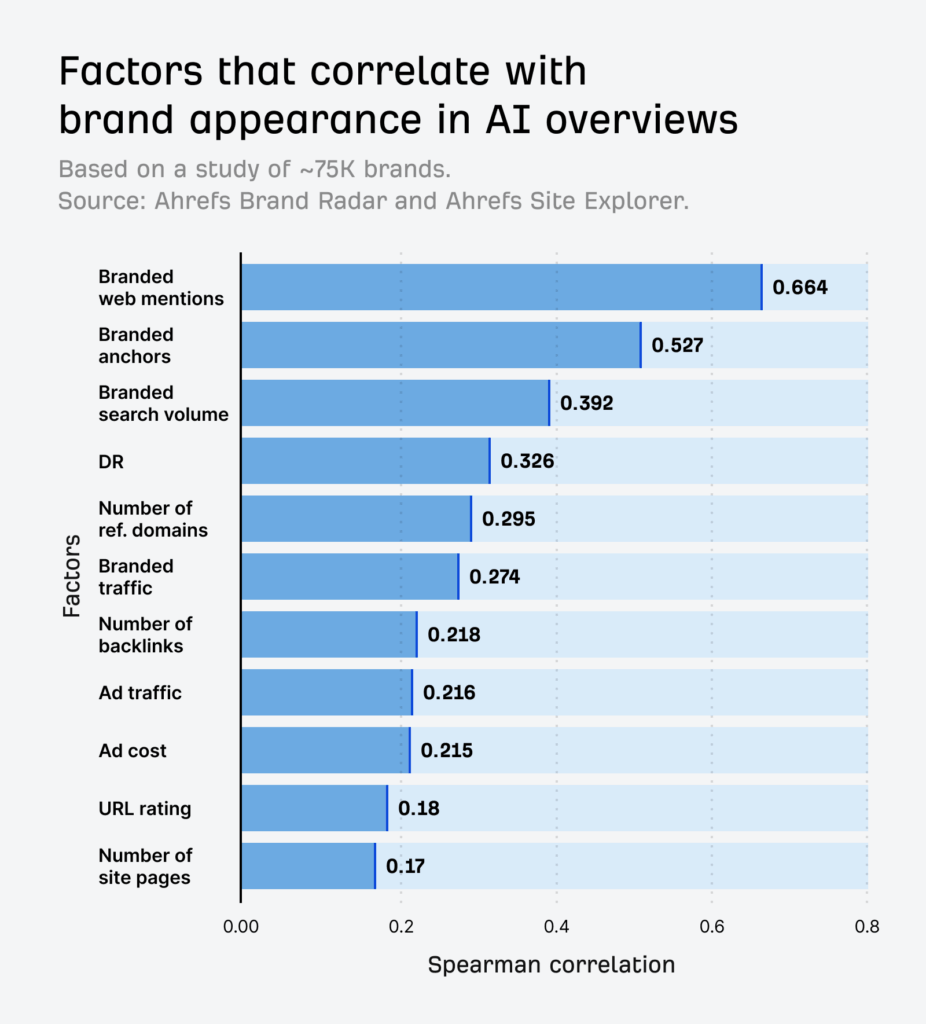
Here are the key factors influencing brand mentions in AI Overviews:
1. Branded Web Mentions and Branded Anchors (The Two Most Powerful Signals)
Why it matters: If there’s one factor that consistently influences whether a brand appears in Google’s AI Overviews, it’s branded mentions across the web.
Every time your brand name appears in relevant editorial contexts — whether linked or unlinked — it strengthens your brand’s digital footprint. Mentions in blog posts, industry publications, listicles, reviews, and news coverage signal that your brand is actively discussed and recognized within its niche.
Branded anchors amplify this effect even further. When websites link to you using your brand name (for example, “BrandName,” “BrandName software,” or “BrandName tools”), they send clear identity signals to search engines. These anchors help Google and AI systems understand exactly who you are and what you’re known for.
In the context of AI Overviews, this matters because generative systems prioritize brands that demonstrate consistent third-party validation. A company that is frequently referenced across authoritative sites is far more likely to be treated as a trusted source worth citing.
🔸 Brands that are talked about get remembered — and remembered brands get surfaced in AI answers.
2. Branded Search Volume (A Sign of Demand)
Why it matters: Growing branded search volume is one of the clearest indicators that a brand is gaining real-world traction.
When users actively search for your company by name, it signals demand, awareness, and trust. Search engines interpret rising branded queries as proof that your brand is relevant and important within its market.
For AI Overviews, this acts as a reinforcement signal. Brands that users repeatedly seek out are more likely to be recognized as authoritative references. High branded search volume suggests that people don’t just stumble upon your brand—they intentionally look for it.
This creates a feedback loop:
- Stronger authority → higher likelihood of AI citations
- More awareness → more branded searches
- More branded searches → stronger authority signals
🔸 Brands that consistently generate search interest build a reputation layer that AI systems can’t ignore.
3. Domain Authority Still Signals Authority
Why it matters: Beyond individual tactics, overall domain authority remains a foundational factor in whether a brand gets cited in Google’s AI Overviews.
Authority is built through a combination of high-quality backlinks, editorial recognition, consistent publishing, and long-term trust signals. When a website is repeatedly referenced by reputable sources and demonstrates expertise within its niche, search engines interpret it as a credible authority.
AI systems tend to favour citing sources that already have a strong reputation for reliability. Established authority reduces uncertainty — it tells Google that your content is more likely to be accurate, trustworthy, and worth surfacing in summaries.
Importantly, authority isn’t just about chasing metrics. It’s about building a sustained presence across respected publications, earning genuine editorial links, and consistently producing valuable content.
🔸 Brands that invest in long-term authority building create a durable advantage in AI-driven search visibility.
4. Referring Domains Matter More Than Backlink Quantity
Why it matters: When it comes to influencing AI visibility, link diversity outweighs sheer volume.
Multiple backlinks from the same website provide diminishing returns. What truly strengthens authority is earning links from a wide range of unique domains. Each new referring domain represents an independent vote of confidence.
Google’s AI systems appear to prioritize brands that demonstrate broad ecosystem validation. A diverse backlink profile suggests your brand is recognized across multiple communities, publications, and audiences — not confined to a small network.
🔸 This is why a strategy focused on acquiring links from many high-quality, relevant sites is more effective than chasing hundreds of repetitive links from a handful of sources. In the AI era, diversity signals legitimacy.
5. Branded Traffic (A Supporting Authority Signal)
Why it matters: Branded traffic — visitors arriving specifically to engage with your brand — plays a supporting role in building authority.
While it’s not as dominant as mentions or search volume, consistent branded traffic reinforces the idea that your brand attracts genuine interest. It indicates user loyalty, repeat engagement, and recognition.
For AI systems, this contributes to a broader picture of brand strength. A company that continuously draws direct attention is more likely to be perceived as established and trustworthy.
🔸 Think of branded traffic as a secondary validation layer. It doesn’t create authority on its own, but it strengthens the ecosystem of signals that influence whether a brand is surfaced in AI Overviews.
6. Topical Authority & Entity Association
Why it matters: AI Overviews don’t just cite strong brands—they cite brands that are clearly associated with a topic cluster.
If your brand is repeatedly mentioned in context with a niche (e.g., “SaaS link building,” “B2B SEO”, “AI visibility”), Google starts treating your brand as an entity authority in that domain.
Signals that build this:
- Consistent co-occurrence of your brand and niche keywords
- Expert commentary/quotes across industry publications
- Listicle inclusion in category-specific roundups
- Knowledge graph/entity alignment
🔸 A brand that’s famous but topically diluted gets cited less than a smaller brand with a tight topical focus
7. Citation-Friendly Content Formats
Why it matters: AI Overviews favour content that’s easy to extract and summarize.
Certain formats are disproportionately cited:
- Comparison articles (“X vs Y”)
- Best-of listicles
- Data-driven research & stats pages
- Step-by-step guides
- Definition-style explainers
These formats map cleanly to how AI synthesizes answers.
🔸 It’s not just who you are—it’s how structured your content is for machine extraction.
8. Content Freshness & Update Velocity
Why it matters: AI Overviews lean toward recently updated, actively maintained content — especially in fast-moving niches.
Signals include:
- Visible update timestamps
- Regular content refresh cycles
- New inbound mentions over time
- Ongoing publishing cadence
🔸 Dormant brands lose AI visibility even if they once had authority.
9. Engagement & Behavioral Signals (Indirect but Real)
Why it matters: While Google doesn’t publicly confirm specifics, engagement signals likely influence training and ranking feedback loops.
Examples:
- Click-through rates
- Dwell time
- Repeat brand interactions
- Social amplification
🔸 Content that consistently satisfies users gets reinforced in AI Overviews.
10. Structured Data & Technical Hygiene
Why it matters: Clean technical signals help AI systems interpret your brand and content correctly.
Key elements:
- Schema markup (Organization, Article, FAQ)
- Clear author attribution (E-E-A-T signals)
- Crawlability & site architecture
- Fast loading & mobile optimization
🔸 This doesn’t create authority — but it prevents friction in how AI parses your site.
11. Cross-Platform Brand Presence
Why it matters: AI models ingest information from multiple ecosystems, not just traditional web pages.
Strong signals come from:
- Reddit discussions
- Industry forums
- YouTube mentions
- Social platforms
- Podcasts
- Review sites
🔸 Brands that exist everywhere their audience talks have more surface area for AI citation. For SaaS brands, Reddit is especially powerful here.
12. Sentiment & Trust Signals
Why it matters: AI systems don’t just track mentions — they track how your brand is discussed.
Positive signals:
- Reviews
- Case studies
- Testimonials
- Editorial endorsements
- Neutral-to-positive sentiment in discussions
🔸 Controversial or low-trust brands get cited less frequently.
Strategies To Rank In AI Overviews
Ranking in Google’s AI Overviews isn’t accidental. It’s the result of deliberate brand engineering across mentions, authority, and visibility ecosystems. At SAASY LINKS, we treat AI Overview visibility as a system — not a single SEO tactic.
Here are the core strategies brands use to consistently earn mentions in AI-generated summaries:
1. Get More Brand Mentions
Brands that consistently appear in AI Overviews don’t rely on passive PR — they run deliberate, structured brand mention campaigns.
This means securing recurring references to your brand across trusted industry publications, where your company is mentioned naturally within relevant editorial contexts. Each mention acts as an independent third-party validation, reinforcing the idea that your brand is recognized and actively discussed within its niche.
As these mentions accumulate, your brand becomes more familiar to Google’s AI systems. Familiar brands are easier to trust, easier to recognize, and far more likely to be surfaced in AI-generated summaries.
At SAASY LINKS, our Brand Mentions Service is built specifically to expand your editorial footprint and increase the probability of AI citation. We focus on placing your brand inside authoritative conversations across niche-relevant websites, creating a steady stream of high-quality references that compound over time.
2. Stimulate Branded Search Demand
Branded search demand doesn’t grow by accident — it’s engineered through repeated exposure in the right environments.
When users encounter your brand consistently across trusted publications, community discussions, and industry roundups, curiosity builds. That curiosity translates into branded searches. And to Google’s AI systems, rising branded search volume is one of the clearest signals of real-world authority and relevance.
The goal isn’t just visibility — it’s memorability. Your brand should appear often enough in high-intent contexts that prospects naturally search for you by name when evaluating solutions.
As branded searches increase, AI systems gain stronger confidence that your company is a recognized player in its niche — making it more likely to surface your brand in AI-generated summaries.
In the AI search era, brands that actively drive demand don’t just get discovered. They get remembered.
3. Build Compounding Domain Authority
Authority isn’t built through shortcuts — it compounds through consistent acquisition of high-quality editorial backlinks.
Each credible placement transfers trust. When respected publications reference your brand in relevant contexts, they signal to Google that your company belongs in authoritative industry conversations. Over time, these signals stack into a reputation layer that AI systems interpret as reliability.
As this authority compounds, your brand becomes a more natural reference point for AI systems — increasing the likelihood of being cited in AI-generated summaries.
At SAASY LINKS, we focus on editorial link building, prioritizing niche relevance and long-term authority over volume. Every placement is designed to strengthen a durable credibility framework.
4. Get Links From Unique Referring Domains
In the AI search landscape, authority isn’t measured by how many backlinks you have — it’s measured by how many independent sources validate your brand.
Google’s systems place greater weight on link diversity than raw link volume. Ten links from ten different reputable websites send a far stronger credibility signal than fifty links from the same domain. Each new referring domain represents an independent endorsement that expands your authority footprint.
For brands targeting AI Overview visibility, the objective is to steadily grow a network of high-quality, niche-relevant referring domains. This signals that your company is recognized across the broader industry ecosystem — not just within a closed circle of partners.
This diversified validation creates a distributed trust network around your brand. And the broader that network becomes, the more confidently AI systems treat your company as a credible reference point.
In practical terms: brands with wide domain diversity don’t just rank better — they become harder for AI systems to ignore.
At SAASY LINKS, we scale referring domain diversity through curated editorial partnerships with thousands of SaaS publishers. Our focus is on acquiring placements from new, contextually aligned domains that compound authority rather than repeating the same sources.
5. Build Consistent Audience Engagement
Brands that cultivate loyal communities and encourage repeat interactions send powerful signals of trust and relevance. When users return intentionally — whether to read new content, participate in discussions, or follow ongoing conversations — it reinforces the perception that the brand provides sustained value.
Over time, this repeat engagement creates a feedback loop. Active audiences generate more brand interactions, more discussions, and more visibility across the web. These signals contribute to a broader ecosystem of recognition that AI systems observe when determining which sources are credible enough to surface.
In practical terms, brands that maintain ongoing relationships with their audience don’t just attract traffic — they build an engagement infrastructure that strengthens the authority signals supporting AI recognition.
6. Dominate a Clear Category to Build Topical Authority
AI systems favor brands that clearly own a category rather than those with scattered, unfocused visibility.
Category ownership is built by creating dense clusters of content and repeatedly appearing in conversations tied to a specific niche. When your brand is consistently associated with the same themes, tools, and problem spaces, it strengthens your identity as a go-to reference within that domain.
Through targeted listicles and editorial placements, brands can systematically reinforce their presence within their core categories. Each relevant mention strengthens the semantic link between the brand and its niche, helping AI systems understand exactly where the brand fits in the ecosystem.
Over time, this concentrated association builds topical authority. And in the AI search era, depth of association matters far more than broad but shallow visibility across unrelated topics.
7. Prioritize Citation-Friendly Content Formats Like Listicles
Formats like comparison guides, listicles, and clearly organized educational resources align naturally with how AI synthesizes information. These formats present insights in digestible units, making it easier for AI models to identify key points and cite relevant brands.
Because of this, listicle ecosystems have become one of the most powerful surfaces for AI visibility. Brands that consistently appear inside high-quality comparison and roundup articles gain repeated exposure in citation-friendly environments.
In the AI search landscape, being present in citation-friendly formats isn’t optional — it’s a strategic advantage.
At SAASY LINKS, our Listicle Mentions Service places brands inside high-performing listicles across trusted, niche-relevant publications. This structured visibility increases the likelihood that AI systems will recognize and extract your brand when generating summaries.
8. Maintain Continuous Content Freshness
Dormant brands gradually lose momentum in AI-driven search environments.
AI systems tend to favor sources that demonstrate continuous activity and relevance. When brands regularly update their content, publish new material, and maintain an active distribution presence, they signal that their information is current and trustworthy.
Consistent refresh cycles also help reinforce existing authority. Updated articles, new mentions, and ongoing visibility show that a brand is still engaged in its niche rather than relying on past credibility.
These fresh signals sustain citation eligibility over time. In the AI search landscape, recency isn’t just a bonus — it’s a competitive advantage that helps active brands remain visible while inactive ones slowly fade from consideration.
9. Optimize for Authentic Engagement Signals (Reddit)
AI systems increasingly learn from patterns of user satisfaction.
When content consistently answers intent clearly and keeps audiences engaged, it sends strong quality signals. Pages that solve real problems, encourage interaction, and hold attention are more likely to be treated as reliable sources in AI-generated summaries.
Authentic engagement matters more than artificial promotion. Communities quickly detect and reject overt marketing, while genuine participation builds credibility and trust over time.
In the AI ecosystem, engagement isn’t just a vanity metric. It’s a reinforcement mechanism that strengthens how confidently AI systems recognize and surface your brand.
At SAASY LINKS, our Reddit Mentions Service is built around authentic, value-driven participation — not promotional spam. By positioning brands naturally within high-intent discussions, we help generate real engagement and trust signals that compound authority.
10. Strengthen Technical Foundations for AI Recognition
Even the strongest authority signals lose impact if AI systems can’t parse your website cleanly.
Technical SEO acts as the translation layer between your content and machine interpretation. Clean site architecture, fast performance, structured data, and proper indexing ensure that search engines can accurately understand your pages and associate them with the right entities and topics.
When your technical foundation is optimized, the authority you build through mentions and links becomes fully visible and actionable. Without that clarity, important signals can be diluted or misinterpreted.
In the AI search landscape, recognition depends on accessibility. The clearer your site structure and technical signals, the easier it is for AI systems to process, trust, and surface your content.
11. Expand Cross-Platform Brand Presence
AI systems learn from ecosystems, not isolated websites.
They absorb signals from a wide network of platforms where real conversations and recommendations take place. Brands that limit their presence to their own website miss the broader context in which AI models evaluate authority and relevance.
To build meaningful visibility, brands must participate in the spaces where their audience actively discusses tools, problems, and solutions — especially forums and community-driven platforms. These environments generate organic mentions, peer validation, and contextual references that AI systems treat as valuable signals.
A strong multi-platform presence expands your citation surface area. The more environments in which your brand appears naturally and credibly, the more opportunities AI systems have to encounter, understand, and reference your company when generating answers.
12. Build Strong Trust and Reputation Signals
AI systems don’t just measure how visible a brand is — they evaluate how trustworthy it appears.
Signals like reviews, testimonials, and editorial endorsements shape the broader perception of your company across the web. When multiple independent sources validate your brand positively, it reduces uncertainty and strengthens credibility.
These trust indicators act as reputation anchors. They show that real users and respected publications stand behind your brand, which makes AI systems more confident in associating your company with reliable information.
Greater trust translates into greater citation comfort. Brands with strong reputation signals are more likely to be surfaced in AI-generated summaries because they present a lower risk of misinformation and a higher likelihood of user satisfaction.
Conclusion
Ranking in Google’s AI Overviews isn’t driven by a single hack — it’s the result of compounding signals across authority, relevance, and trust. Brands that consistently invest in mentions, engagement, structured visibility, and technical clarity build an ecosystem that AI systems recognize and prioritize.
The brands that win in AI search are the ones that treat visibility as a long-term strategy, not a short-term tactic. In an AI-first landscape, sustained authority becomes your strongest competitive advantage.
FAQs
What are Google AI Overviews?
Google AI Overviews are AI-generated summaries that appear at the top of search results for certain queries. Instead of listing only traditional blue links, Google synthesizes information from multiple sources and highlights selected brands or websites within the summary.
How does Google choose which brands appear in AI Overviews?
Google selects brands based on authority, topical relevance, trust signals, and third-party validation. Factors like branded mentions, editorial backlinks, referring domain diversity, and user engagement all influence citation likelihood.
Are backlinks still important for AI Overviews?
Yes, but quality and diversity matter more than quantity. High-quality editorial backlinks from niche-relevant publications help establish authority, which increases the probability of being cited in AI summaries.
Do branded mentions help with AI visibility?
Absolutely. Branded mentions — even unlinked ones — signal recognition and authority. Consistent third-party references strengthen your brand’s credibility in the eyes of AI systems.
What type of content gets cited most in AI Overviews?
Structured formats such as comparison guides, listicles, definitions, and step-by-step tutorials are more likely to be cited. AI systems favor content that is easy to extract and summarize.
How important is topical authority for AI visibility?
Topical authority is critical. Brands that consistently publish and earn mentions within a specific niche are more likely to be recognized as category leaders and cited in AI-generated answers.
Does Reddit influence AI visibility?
Yes. AI systems learn from ecosystems where real discussions happen. Authentic mentions and participation in Reddit threads can reinforce brand trust and relevance signals.
Does technical SEO impact AI Overview rankings?
Technical SEO ensures that AI systems can properly crawl, interpret, and understand your content. Clean site architecture, structured data, and strong performance support recognition of authority signals.
How can SaaS brands increase their chances of appearing in AI Overviews?
SaaS brands should focus on earning editorial mentions, increasing branded search demand, expanding referring domain diversity, maintaining content freshness, building engagement in communities, and strengthening trust signals across platforms.
