How To Rank in Google's AI Overviews: A Guide for SaaS Brands
 Vikas Kalwani
TL;DR
Ranking in Google's AI Overviews requires building layered authority across 12 key factors: branded mentions, branded search volume, domain authority, referring domain diversity, branded traffic, topical authority, citation-friendly content formats, content freshness, engagement signals, technical SEO, cross-platform presence, and trust signals. There is no single shortcut — the brands that consistently appear have invested in multi-layered authority from multiple independent sources.
Free Playbook
The exact 90-day playbook we run for clients

Google’s AI Overviews are reshaping how users discover brands online. Ranking in these AI-generated summaries requires a fundamentally different approach from traditional SEO. Here are the 12 key factors that determine whether your brand gets cited.
What Matters For AI Overviews
| # | Factor | Why It Matters for AI Overviews | Key Signals / Examples |
|---|---|---|---|
| 1 | Branded Web Mentions & Branded Anchors | Frequent third-party mentions signal recognition and authority. Branded anchors clarify brand identity to AI systems. | Editorial mentions, news coverage, listicles, branded anchor links |
| 2 | Branded Search Volume | Rising branded searches show real user demand and awareness, reinforcing brand authority. | Growth in brand-name queries, navigational searches |
| 3 | Domain Authority & Trust | Established authority increases the likelihood of being treated as a credible source. | Editorial backlinks, expert positioning, long-term reputation |
| 4 | Referring Domain Diversity | AI values validation from many unique sources rather than repetitive links. | Links from diverse high-quality domains |
| 5 | Branded Traffic | Consistent direct engagement reinforces brand strength and recognition. | Direct visits, repeat users, loyal audience behavior |
| 6 | Topical Authority & Entity Association | Brands strongly associated with a niche are more likely to be cited in that topic area. | Keyword co-occurrence, niche mentions, expert quotes |
| 7 | Citation-Friendly Content Formats | Structured formats are easier for AI to extract and summarize. | Comparisons, listicles, guides, research pages |
| 8 | Content Freshness & Update Velocity | Recently updated content is favored in fast-moving industries. | Update timestamps, publishing cadence |
| 9 | Engagement & Behavioral Signals | High user satisfaction reinforces content quality signals. | CTR, dwell time, repeat engagement |
| 10 | Structured Data & Technical Hygiene | Clean technical signals help AI interpret and trust your content. | Schema markup, site speed, crawlability |
| 11 | Cross-Platform Brand Presence | AI learns from multiple ecosystems beyond traditional websites. | Reddit, forums, YouTube, social platforms |
| 12 | Sentiment & Trust Signals | Positive reputation increases the chance of citation. | Reviews, testimonials, editorial endorsements |
Strategies That Work
| # | Strategy | Core Idea | Practical Focus |
|---|---|---|---|
| 1 | Engineer Branded Mention Campaigns | AI favors brands repeatedly referenced by trusted third parties | Secure consistent brand mentions across niche editorial publications |
| 2 | Stimulate Branded Search Demand | Growing brand searches signal real-world authority | Increase exposure that drives users to search for your brand directly |
| 3 | Build Long-Term Editorial Authority | High-quality editorial backlinks compound credibility | Earn placements on respected niche publications |
| 4 | Expand Referring Domain Diversity | Validation from many domains outweighs link volume | Acquire links from new, relevant websites at scale |
| 5 | Strengthen Audience Engagement | Loyal audiences reinforce authority signals | Build repeat engagement and community interaction |
| 6 | Dominate a Clear Category | Topical ownership increases AI association | Focus visibility around a tight niche cluster |
| 7 | Use Citation-Friendly Formats | Structured content is easier for AI to extract | Appear in listicles, comparisons, and guides |
| 8 | Maintain Content Freshness | Active brands retain AI momentum | Update and publish content consistently |
| 9 | Optimize for Authentic Engagement | User satisfaction strengthens trust signals | Encourage genuine participation in communities |
| 10 | Strengthen Technical Foundations | Clean sites are easier for AI to interpret | Improve crawlability, structure, and performance |
| 11 | Expand Cross-Platform Presence | AI learns from ecosystems, not silos | Be visible in forums and discussion platforms |
| 12 | Build Trust & Reputation Signals | Trust increases citation confidence | Generate reviews, testimonials, and endorsements |
What Drives AI Overview Visibility
Ahrefs analyzed 75,000 brands to see which search factors are most likely to influence brand mentions in AI Overviews.
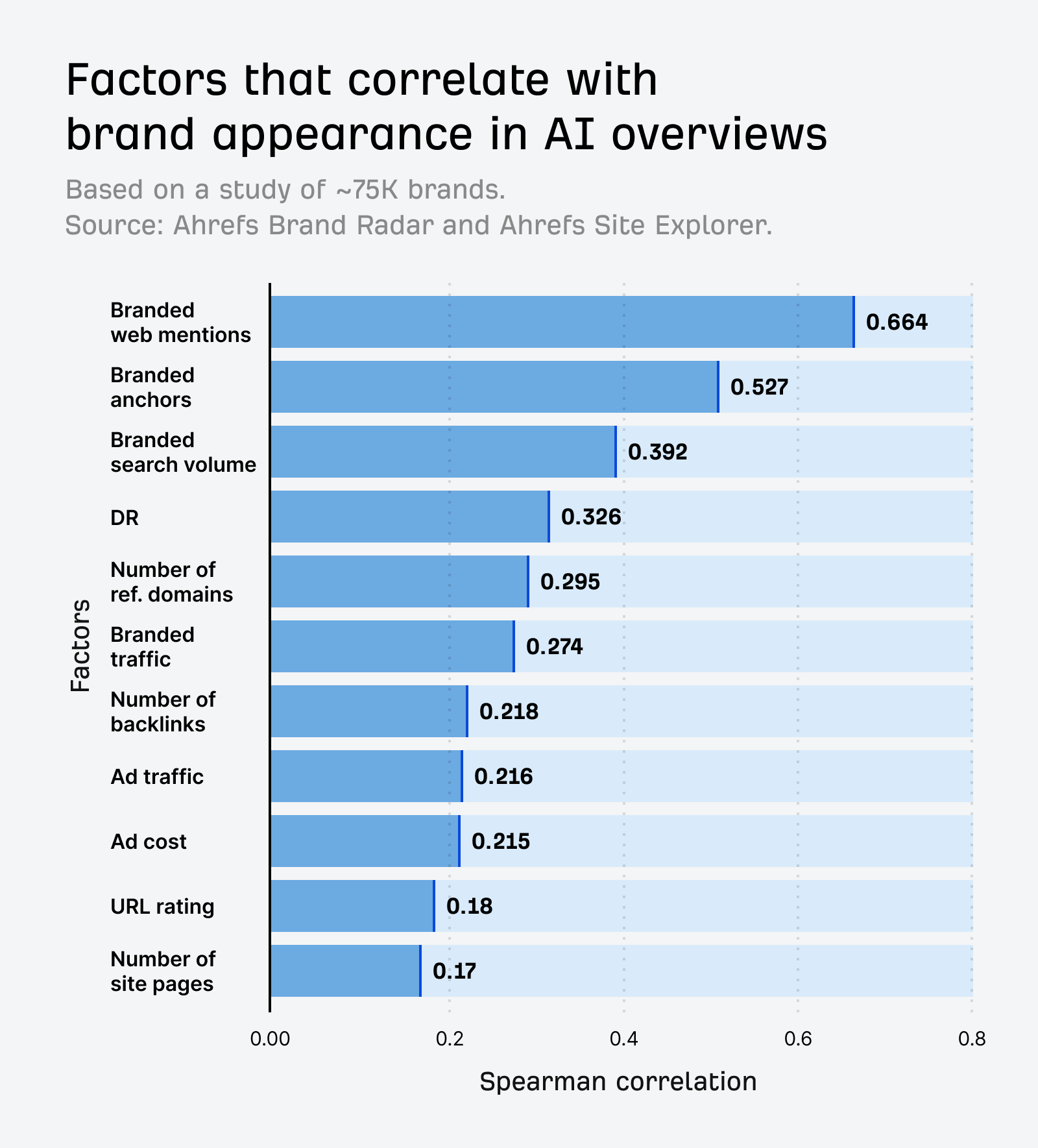
Appearing in AI Overviews is not about gaming an algorithm. It is about building layered authority through editorial placements, community engagement, and consistent third-party validation. Each of these 12 factors contributes to how AI systems perceive and recommend your brand. An AI SEO agency can help you execute across all of them.
1. Branded Mentions
Why it matters: If there’s one factor that consistently influences whether a brand appears in Google’s AI Overviews, it’s branded mentions across the web.
Every time your brand name appears in relevant editorial contexts — whether linked or unlinked — it strengthens your brand’s digital footprint. Mentions in blog posts, industry publications, listicles, reviews, and news coverage signal that your brand is actively discussed and recognized within its niche.
Branded anchors amplify this effect even further. When websites link to you using your brand name (for example, “BrandName,” “BrandName software,” or “BrandName tools”), they send clear identity signals to search engines. These anchors help Google and AI systems understand exactly who you are and what you’re known for.
In the context of AI Overviews, this matters because generative systems prioritize brands that demonstrate consistent third-party validation. A company that is frequently referenced across authoritative sites is far more likely to be treated as a trusted source worth citing.
🔸 Brands that are talked about get remembered — and remembered brands get surfaced in AI answers.
2. Branded Search Volume
Why it matters: Growing branded search volume is one of the clearest indicators that a brand is gaining real-world traction.
When users actively search for your company by name, it signals demand, awareness, and trust. Search engines interpret rising branded queries as proof that your brand is relevant and important within its market.
For AI Overviews, this acts as a reinforcement signal. Brands that users repeatedly seek out are more likely to be recognized as authoritative references. High branded search volume suggests that people don’t just stumble upon your brand—they intentionally look for it.
This creates a feedback loop:
- Stronger authority → higher likelihood of AI citations
- More awareness → more branded searches
- More branded searches → stronger authority signals
🔸 Brands that consistently generate search interest build a reputation layer that AI systems can’t ignore.
3. Domain Authority
Why it matters: Beyond individual tactics, overall domain authority remains a foundational factor in whether a brand gets cited in Google’s AI Overviews.
Authority is built through a combination of high-quality backlinks, editorial recognition, consistent publishing, and long-term trust signals. When a website is repeatedly referenced by reputable sources and demonstrates expertise within its niche, search engines interpret it as a credible authority.
AI systems tend to favour citing sources that already have a strong reputation for reliability. Established authority reduces uncertainty — it tells Google that your content is more likely to be accurate, trustworthy, and worth surfacing in summaries.
Importantly, authority isn’t just about chasing metrics. It’s about building a sustained presence across respected publications, earning genuine editorial links, and consistently producing valuable content.
🔸 Brands that invest in long-term authority building create a durable advantage in AI-driven search visibility.
4. Referring Domain Diversity
Why it matters: When it comes to influencing AI visibility, link diversity outweighs sheer volume.
Multiple backlinks from the same website provide diminishing returns. What truly strengthens authority is earning links from a wide range of unique domains. Each new referring domain represents an independent vote of confidence.
Google’s AI systems appear to prioritize brands that demonstrate broad ecosystem validation. A diverse backlink profile suggests your brand is recognized across multiple communities, publications, and audiences — not confined to a small network.
🔸 This is why a strategy focused on acquiring links from many high-quality, relevant sites is more effective than chasing hundreds of repetitive links from a handful of sources. In the AI era, diversity signals legitimacy.
5. Branded Traffic
Why it matters: Branded traffic — visitors arriving specifically to engage with your brand — plays a supporting role in building authority, and understanding how to get mentioned by AI tools like ChatGPT can significantly amplify this.
While it’s not as dominant as mentions or search volume, consistent branded traffic reinforces the idea that your brand attracts genuine interest, indicating user loyalty, repeat engagement, and recognition, especially when considering new AI search visibility strategies.
For AI systems, this contributes to a broader picture of brand strength. A company that continuously draws direct attention is more likely to be perceived as established and trustworthy.
🔸 Think of branded traffic as a secondary validation layer. It doesn’t create authority on its own, but it strengthens the ecosystem of signals that influence whether a brand is surfaced in AI Overviews.
6. Topical Authority
Why it matters: AI Overviews don’t just cite strong brands—they cite brands that are clearly associated with a topic cluster.
If your brand is repeatedly mentioned in context with a niche (e.g., “SaaS link building,” “B2B SEO”, “AI visibility”), Google starts treating your brand as an entity authority in that domain.
Signals that build this:
- Consistent co-occurrence of your brand and niche keywords
- Expert commentary/quotes across industry publications
- Listicle inclusion in category-specific roundups
- Knowledge graph/entity alignment
🔸 A brand that’s famous but topically diluted gets cited less than a smaller brand with a tight topical focus
7. Citation-Friendly Content Formats
Why it matters: AI Overviews favour content that’s easy to extract and summarize.
Certain formats are disproportionately cited:
- Comparison articles (“X vs Y”)
- Best-of listicles
- Data-driven research & stats pages
- Step-by-step guides
- Definition-style explainers
These formats map cleanly to how AI synthesizes answers.
🔸 It’s not just who you are—it’s how structured your content is for machine extraction.
8. Content Freshness
Why it matters: AI Overviews lean toward recently updated, actively maintained content — especially in fast-moving niches.
Signals include:
- Visible update timestamps
- Regular content refresh cycles
- New inbound mentions over time
- Ongoing publishing cadence
🔸 Dormant brands lose AI visibility even if they once had authority.
9. Engagement Signals
Why it matters: While Google doesn’t publicly confirm specifics, engagement signals likely influence training and ranking feedback loops.
Examples:
- Click-through rates
- Dwell time
- Repeat brand interactions
- Social amplification
🔸 Content that consistently satisfies users gets reinforced in AI Overviews.
10. Technical SEO
Why it matters: Clean technical signals help AI systems interpret your brand and content correctly.
Key elements:
- Schema markup (Organization, Article, FAQ)
- Clear author attribution (E-E-A-T signals)
- Crawlability & site architecture
- Fast loading & mobile optimization
🔸 This doesn’t create authority — but it prevents friction in how AI parses your site.
11. Cross-Platform Presence
Why it matters: AI models ingest information from multiple ecosystems, not just traditional web pages.
Strong signals come from:
- Reddit discussions
- Industry forums
- YouTube mentions
- Social platforms
- Podcasts
- Review sites
🔸 Brands that exist everywhere their audience talks have more surface area for AI citation, and for those seeking to enhance their AI visibility, Reddit is especially powerful here.
12. Trust Signals
Why it matters: AI systems don’t just track mentions — they track how your brand is discussed.
Positive signals:
- Reviews
- Case studies
- Testimonials
- Editorial endorsements
- Neutral-to-positive sentiment in discussions
🔸 Controversial or low-trust brands get cited less frequently.
The Bottom Line
There is no single shortcut to ranking in AI Overviews. The brands that consistently appear are those that have invested in building multi-layered authority: earning editorial placements on respected publications, engaging authentically in communities where their audience gathers, and accumulating consistent third-party validation across the web.
When AI systems evaluate which brands to recommend, they look for convergent evidence from multiple independent sources. The more signals you build across these 12 factors, the harder you become to ignore.
Want expert help ranking in AI Overviews? Our GEO and AEO agency specializes in building the signals that AI search platforms use to cite and recommend SaaS brands.
FAQs
What are AI Overviews in Google?
AI Overviews are AI-generated summaries that appear at the top of Google search results. They synthesize information from multiple sources to provide direct answers to user queries, citing the brands and websites they reference.
How is ranking in AI Overviews different from traditional SEO?
Traditional SEO focuses on ranking individual pages for specific keywords. AI Overviews evaluate your brand’s overall authority, trustworthiness, and presence across the web. It requires building layered signals from multiple independent sources rather than optimizing a single page.
Do backlinks help with AI Overview rankings?
Yes. Domain authority and referring domain diversity are key factors. AI systems use backlinks as signals of credibility and authority. Editorial backlinks from diverse, reputable sources significantly increase your chances of being cited in AI-generated summaries.
How important is branded search volume for AI Overviews?
Very important. When users actively search for your brand by name, it signals to Google that your brand is noteworthy and trusted. Higher branded search volume increases the likelihood of your brand being included in AI-generated summaries.
What content format works best for AI Overviews?
Citation-friendly formats work best: clear definitions, concise summaries, numbered lists, comparison tables, and direct answers to common questions. AI systems prefer scannable, well-organised content they can easily extract and cite.
How long does it take to start appearing in AI Overviews?
There is no fixed timeline. Building the layered authority required for AI Overview inclusion is a long-term investment. Most brands see progress within 3 to 6 months of consistent effort across editorial placements, content optimization, and cross-platform presence.
Need help getting your SaaS brand into AI Overviews? Our AI SEO services combine editorial link building, listicle mentions, and Reddit presence to build the signals AI models use to recommend brands.

Get Your SaaS Ranked on Google & Cited by AI
Senior-led AI SEO combining strategy, content, editorial links, and AI optimization in 90-day sprints. Built exclusively for B2B SaaS.
Book a Free Consultation CallBuilt exclusively for SaaS.