How to Rank in ChatGPT and Get Your Brand Cited (2026)

TL;DR
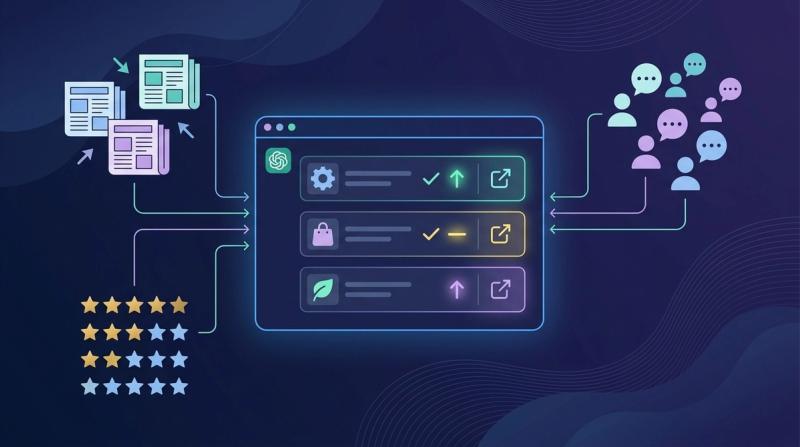
ChatGPT doesn't rank brands based on website quality. It ranks brands that appear across multiple trusted third-party sources. Wikipedia (13.15%) and Reddit (11.97%) lead ChatGPT citations, but no single domain exceeds 5% of total share. ChatGPT evaluates 2.5x more sources than it cites, and only 27.5% get mentioned by name. The winning formula: editorial mentions on DR 50+ publications, active G2/Capterra profiles (4.6–6.3x citation multiplier), authentic Reddit presence, and consistent LinkedIn content.
Free Playbook
The exact 90-day playbook we run for clients

Most "rank in ChatGPT" guides tell you to add FAQ schema and hope for the best. That's backwards. ChatGPT doesn't read your schema. It reads the publications that mention you. We've seen brands with perfect on-page SEO get zero mentions, and brands with mediocre websites get cited constantly because they show up everywhere that matters.
ChatGPT has 810 million daily users and processes 2.5 billion prompts per day. Roughly 875 million of those trigger a web search. Every one of those searches pulls from somewhere, and the sites ChatGPT chooses to cite follow clear, measurable patterns.
According to Similarweb's analysis of nearly 600,000 citation events, Wikipedia accounts for 13.15% of all ChatGPT citations. Reddit is second at 11.97%. But no single domain exceeds roughly 5% of total citations beyond those two. The remaining 95% spreads across thousands of sites.
That means there's real opportunity for SaaS brands to rank in ChatGPT. You just need to show up in the right places. Here's what our AI visibility work has shown actually works.
How Ranking in ChatGPT Differs From Google in 2026
Ranking in ChatGPT works differently from ranking in Google. Google rewards on-page SEO. ChatGPT rewards off-site presence across trusted sources.
Google ranking factors vs ChatGPT ranking factors
| Factor | ChatGPT | |
|---|---|---|
| Backlinks | Direct ranking signal | Indirect — builds DA, which correlates with citations |
| On-page SEO | Primary factor | Minimal direct impact on citations |
| Third-party mentions | Helps E-E-A-T | Primary citation trigger |
| Review profiles (G2, Capterra) | Local SEO signal | 4.6–6.3x citation multiplier |
| Reddit presence | Minimal impact | 11.97% of all ChatGPT citations |
| Content freshness | Moderate factor | 36.7% of queries filter by year |
| Schema markup | Helps featured snippets | No direct impact on ChatGPT citations |
Google's top position captures 27-30% of clicks. ChatGPT's top cited domain rarely exceeds 5% of citations. The playing field is more distributed, which means a well-executed brand presence can punch above its weight.
An OppAlerts study of 167,000 domains confirmed this overlap: ranking in Google, topical clarity, and backlinks all directly boost AI recommendations. There's no separate "AI SEO" playbook. The fundamentals carry across both channels.
How ChatGPT Selects Which Brands to Cite
ChatGPT evaluates roughly 2.5x more sources than it actually cites. Only 39.5% of evaluated sources end up in the response, and just 27.5% get mentioned by name. This comes from Dmytro Sokhach's analysis of 45,144 ChatGPT fan-out queries — the sub-searches it runs before generating an answer.
Of those fan-out queries, 45% use the site: operator (ChatGPT checks specific domains it already trusts), 42.8% include the word "official" (it prefers authoritative sources), and 36.7% mention a specific year (it filters for recency). Only 7% search for reviews or Reddit content.
Your brand needs to appear across multiple trusted sources to have a realistic shot at being cited. One mention on one site isn't enough. ChatGPT cross-references, and it's picky.
The Citation Funnel: From Discovery to Recommendation
We call ChatGPT's brand selection process the Citation Funnel Model. It has four stages, and your brand needs to pass through all of them to get named in an answer.

At the Discovery stage, ChatGPT runs fan-out queries to find candidate sources. During Validation, it cross-references what it finds across editorial publications, review platforms, Reddit, LinkedIn, and YouTube. At the Citation stage, only 39.5% of evaluated sources make the response, and just 27.5% get named. And at Reinforcement, brands that get cited consistently across many user queries build stronger associations over time.
SAASY LINKS ran a brand visibility campaign for a B2B analytics SaaS client that went from 0 to 47 editorial brand mentions in 4 months. Organic traffic increased 62%, and the client started appearing in ChatGPT responses for 3 high-intent product queries. That's the funnel in action: enough Discovery-stage mentions triggered Validation, which led to consistent Citations.
8 Ways to Get Your Brand Cited by ChatGPT
Earn mentions on authoritative third-party sites
Forbes, Business Insider, TechRadar, and Reuters are all top-10 ChatGPT citation sources. Getting your brand mentioned in articles on these publications puts you directly in the pool of sources ChatGPT draws from. Editorial link building for SaaS is the most direct path to earning these mentions.
Contextual relevance matters more than domain authority alone. A mention in a generic business article won't move the needle. But a mention in a "best project management tools for startups" listicle on a DR 70+ publication will. Target publications that already rank for the queries you want ChatGPT to associate with your brand.
Get featured in expert roundups and listicles
"Best of" listicles combine two of ChatGPT's strongest citation signals: authoritative domains and structured, product-specific content. Listicle placements for SaaS target exactly this: earning spots in curated roundup posts that both rank on Google and feed into ChatGPT's answers.
“'Best X' blog listicles are the single most prominent content format cited by AI chatbots. They make up 43.8% of all page types cited by ChatGPT specifically.”
SAASY LINKS' analysis of 200+ listicle placements found that pages featured in 3+ "best of" lists saw an average 47% organic traffic increase within 90 days. The compounding effect matters: each additional listicle mention creates another citation touchpoint ChatGPT can validate against.
Use branded link building to reinforce associations
ChatGPT builds its understanding of brands through co-occurrence patterns. When your brand name repeatedly appears near category keywords ("best project management tool," "CRM for SaaS"), ChatGPT strengthens that association. Branded anchor text in editorial backlinks is one of the most reliable ways to build these semantic connections.
Pick 3-5 category keywords you want ChatGPT to associate with your brand and build links with those terms appearing naturally near your brand name. Consistency across sources is what trains the model.
Create long-form, structured content on your site
While third-party mentions are the primary driver, your own site still matters. ChatGPT's fan-out queries use the site: operator 45% of the time, meaning it checks specific domains for specific information. The more well-structured pages you have, the more surface area ChatGPT has to find and cite you.
Use clear H2/H3 headings (question format where natural), include specific data points and named sources, and keep paragraphs short. Build narrowly focused pages like integration pages, use case pages, comparison pages, and pricing pages rather than a few broad ones. ChatGPT rewards specificity.
Get listed on structured data sources
Product directories like Product Hunt, AlternativeTo, SaaSWorthy, and StackShare are structured data sources that ChatGPT can easily parse. Each listing acts as an independent data point confirming your brand exists in a specific category. Complete every field: description, category tags, feature lists, screenshots, pricing. Incomplete profiles are noise. Complete ones are citation-ready data.
Build presence in AI-crawled communities
Reddit accounts for 11.97% of all ChatGPT citations. But Reddit's share dropped from roughly 60% to 10-12% after September 2025, so it's no longer sufficient on its own. A focused Reddit marketing approach for SaaS should be one channel in a broader plan, not the entire plan.
Quora has a 4.1x citation multiplier, the highest of any community platform. Stack Overflow matters for developer tools. The pattern: answer real questions in communities ChatGPT already trusts, with your brand name mentioned naturally where relevant.
Expand your review footprint across platforms
Brands on multiple review platforms (G2, Capterra, Trustpilot) earn 4.6–6.3x more ChatGPT citations than those on a single platform, according to Contently's 2026 analysis. This cross-platform presence creates the multi-source validation that brand mention services are built to deliver.
And 21.4% of ChatGPT's fan-out queries check pricing. SaaS companies that gate pricing behind "contact sales" are cutting themselves off from a significant share of ChatGPT's evaluation process. Transparent pricing on your site and review profiles gets cited.
Invest in LinkedIn and YouTube content
LinkedIn climbed from #11 to #5 on ChatGPT's citation index between November 2025 and February 2026. It now appears in 14.3% of ChatGPT Search responses. YouTube has the strongest overall correlation (0.737) with AI visibility across all domains.
For B2B SaaS, LinkedIn is where executive thought leadership, company updates, and industry commentary all contribute to ChatGPT citation signals simultaneously. YouTube explainer videos and product demos add another citation surface. Both are cheap to produce and compound over time.
ChatGPT Ads vs Earned Visibility in 2026
ChatGPT launched a self-serve ad platform in 2026 for US businesses. Ads appear alongside AI-generated answers, giving brands a paid shortcut to visibility. But ads and earned citations serve different purposes.
Paid placements disappear when you stop spending. Earned citations persist because they're based on your brand's presence across trusted sources. The best approach treats ads as a complement to earned visibility, not a replacement. Use ads for immediate awareness while you build the editorial, community, and review presence that generates organic citations long-term.
What Doesn't Work for Ranking in ChatGPT
SAASY LINKS tested FAQ schema implementation across 15 client sites. Zero correlation between schema and ChatGPT mentions. What did correlate: the number of independent third-party pages that mentioned the brand. Schema helps Google, not ChatGPT.
Publishing more blog posts on your own site doesn't move the needle either, unless those posts get picked up and referenced by external sources. And meta descriptions, title tags, header structure? Those are Google ranking factors. ChatGPT reads the content, not the metadata.
Stuffing "AI SEO" keywords into existing pages without structural changes is equally useless. ChatGPT doesn't care about keyword density. It cares about answer quality, claim density, and source authority. Keyword stuffing for AI search is the same dead tactic it's always been for Google.
Publishing AI-generated blog posts without human editing is another trap. Google's helpful content system penalizes content created at scale for ranking rather than user value. And ChatGPT won't cite your AI-written article when 10 better human-written pieces already cover the same ground.
How to Track ChatGPT Brand Mentions in 2026
You can't improve what you don't measure. Several tools now track AI citations across ChatGPT and other engines.
AI citation tracking tools (2026)
| Tool | What It Tracks | Best For |
|---|---|---|
| Ahrefs Brand Radar | Brand mentions across ChatGPT, Perplexity, Gemini, AI Overviews | Full-stack SEO teams |
| Profound | AI citation frequency, query-level attribution | Brand monitoring at scale |
| Peec AI | ChatGPT mention tracking, sentiment analysis | SaaS brand teams |
| Evertune | Cross-platform AI citation analysis | Enterprise brands |
| Manual prompting | Spot-check your brand in ChatGPT responses | Anyone (free) |
Set up monthly monitoring: which queries trigger your brand, which pages get cited, citation frequency across ChatGPT, Perplexity, and Gemini, and whether citation sentiment is positive. AI citation tracking should be a standard deliverable in every SEO retainer. If your agency can't tell you how many times your brand was cited last month, they're not paying attention.
Why Multi-Source Credibility Matters for ChatGPT
ChatGPT doesn't have a ranking algorithm like Google's PageRank. It has a pattern-matching system trained on the entire internet. When your brand shows up consistently across editorial publications, Reddit threads, review platforms, LinkedIn posts, and YouTube videos, ChatGPT treats that consistency as a credibility signal. A focused generative engine optimization approach builds exactly this kind of multi-source presence.
There's no separate "AI SEO" playbook. If you rank in Google, build editorial links, and get mentioned on authoritative sites, you'll show up in AI search. The agencies selling "GEO" as a standalone service are selling you traditional SEO with a new label.
For the full playbook on ranking across ChatGPT, Perplexity, and AI Overviews, start with our AI SEO guide. It covers every tactic from editorial placements to entity building.
For the full data on which sites ChatGPT cites most, see our breakdown of the most cited websites in ChatGPT. And for a comparison, our Perplexity citation data shows a very different pattern where brands get cited 22x more often.
Don't want to manage brand mention outreach yourself? We compared the best brand mention services that handle placement, tracking, and reporting for SaaS brands.
Want a team to handle your AI search visibility? Our LLM SEO agency builds the authority and brand signals that get you cited by ChatGPT, Perplexity, and Gemini.
Frequently Asked Questions
How does ChatGPT decide which brands to recommend?
ChatGPT cross-references multiple independent sources before citing a brand. It evaluates roughly 2.5x more sources than it cites, with only 39.5% making it into the response. Brands that appear across editorial publications, review platforms, and community discussions have the highest citation probability.
Can I pay to get my brand mentioned by ChatGPT?
ChatGPT launched a self-serve ad platform in 2026, so paid placements are now possible. But ads disappear when you stop spending. Earned citations from editorial mentions, review profiles, and community presence persist indefinitely.
Do backlinks help with ranking in ChatGPT?
Indirectly. Backlinks build domain authority, and higher-DA sites are more likely to be cited. But the backlink itself isn't the signal. The editorial mention that contains the backlink is what ChatGPT reads.
How important are reviews for ChatGPT visibility?
Very. Brands on multiple review platforms earn 4.6–6.3x more ChatGPT citations than those on a single platform. G2, Capterra, and Trustpilot all appear in ChatGPT's top 50 citation sources.
Does Reddit activity help with ChatGPT rankings?
Yes, but less than it used to. Reddit dropped from 60% citation share to about 10-12% after September 2025. It's still the #2 most cited domain, but should be one channel in a broader approach.
How long does it take to rank in ChatGPT?
Tier-1 journalism mentions can get picked up within 24 hours to 7 days. Building broad enough third-party presence to rank consistently takes 60-90 days of sustained effort across editorial placements, review profiles, and community engagement.
What percentage of ChatGPT citations come from listicles?
43.8% of all page types cited by ChatGPT are "best X" blog listicles, according to Ahrefs' analysis of 26,283 URLs. Getting featured in multiple listicles across different publications is one of the highest-ROI tactics for ChatGPT visibility.
How can I track whether ChatGPT mentions my brand?
Use Ahrefs Brand Radar, Profound, Peec AI, or Evertune to monitor AI citations across ChatGPT and other engines. For a free approach, manually prompt ChatGPT with queries your customers would use and check whether your brand appears in the response.

Written by
Co-founder & CEO of SAASY LINKS, the B2B SaaS link building and AI visibility agency. 10+ years in SEO and growth marketing for SaaS brands. Mentor at 500 Startups and Techstars. Runs the Backlink Masterminds community for link builders.
Get Your SaaS Ranked on Google & Cited by AI
Senior-led AI SEO combining strategy, content, editorial links, and AI optimization in 90-day sprints. Built exclusively for B2B SaaS.
Book a Free Consultation CallBuilt exclusively for SaaS.