How Many Backlinks Do I Need to Rank? (2026 Data)

TL;DR
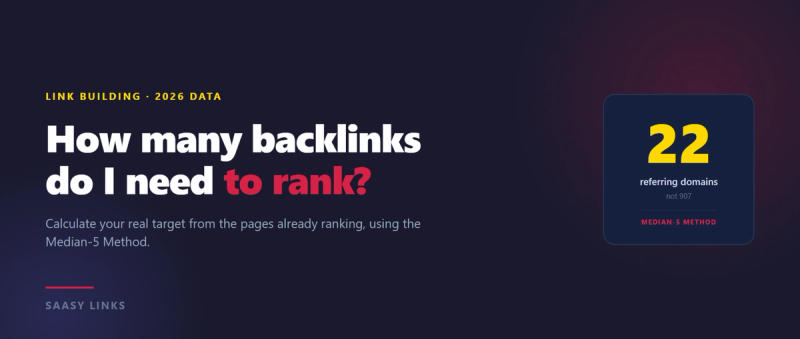
Nobody can give you a number without looking at your SERP first. The pages ranking for your keyword have already answered the question. Pull the results sitting at positions 3 through 7, take the median count of referring domains pointing at those specific URLs, then add about 20% for the quality gap. SAASY LINKS calls this the Median-5 Method. For mid-competition B2B SaaS keywords it usually lands between 15 and 60 referring domains per page, well under the hundreds most guides quote. Positions 1 and 2 get excluded on purpose, because they're usually brand-authority outliers that inflate your target and your budget along with it.
Free Playbook
The exact 90-day playbook we run for clients

How many backlinks do you need to rank?
Between 15 and 60 referring domains for a typical mid-competition B2B SaaS page, and several thousand for broad finance terms. No universal number exists, because the target is relative. You need enough linking domains to close the gap between your page and the weakest page currently outranking you.
The spread across industries is wider than most articles admit. WebFX studied 1,462 domains across 15 industries in 2026 and found page-one sites carried a median of 907 referring domains. Apparel sites got there on 76. Finance and insurance sites needed 3,027, roughly 40 times more. Any number quoted without an industry attached to it tells you close to nothing.
Those are site-wide figures, though. The number you actually plan against is smaller, more specific, and cheaper to hit than the headline stats suggest. Anyone asking how many backlinks do I need to rank is usually one calculation away from an answer they can budget against.
Why referring domains beat raw backlink count
A referring domain is one website linking to you. A backlink is one individual link. Forty links from the same blog still count as a single referring domain, and Google treats them roughly that way. Every credible ranking correlation study measures domains rather than links, so your target should be set in domains too.
Google has been unusually blunt here. In a Search Central hangout, John Mueller said "the total number [of backlinks] essentially is completely irrelevant" to rankings, adding that one good link from a relevant site can outweigh millions of low-quality ones. That's about as close to a direct answer as Google gives on link counting.
The second correction is page-level counting, and it's the one that costs SaaS teams the most money. Your domain might have 800 referring domains while the URL you're trying to rank has three. Google ranks pages. When you set a target, count the domains pointing at the exact URL competing for that keyword, not the ones pointing at your homepage.
Ahrefs' study of roughly 14 billion pages found that 55% of pages have no referring domains at all and 96.55% get zero traffic from Google. One detail in that data matters more than either headline: almost 70,000 pages carry links from over 200 referring domains and still pull zero search traffic. Volume on its own ranks nothing, which is why powerful backlinks beat plentiful ones on every SERP worth competing for.
How many backlinks from one website actually count?
Effectively one, for target-setting purposes. The first link from a new domain carries most of the value, and each additional link from that same site adds progressively less. Google isn't ignoring links two through forty, but it isn't counting them as forty either.
This has a practical consequence that changes how you buy links. A publisher offering you five placements across their site is selling you one referring domain at five times the price. Five separate publishers at DR 40 will outperform one publisher at DR 70 giving you five links, almost every time. Spread the budget across domains.
The exception is sitewide footer or sidebar links, which appear on thousands of pages from a single domain. Those get discounted hardest of all, and a profile built on them looks bought from the outside. Count the domain once and move on.
The Median-5 Method: how to calculate your real backlink target
The Median-5 Method sets your target from the five results at positions 3 through 7 rather than the full top 10. Take the median page-level referring domains across those five URLs, then add 20% if their links are stronger than what you can realistically earn. It takes about ten minutes and gives you one number.
It also reframes the question into one that has an answer. How many backlinks do I need to rank is unanswerable as a general question and straightforward as a per-keyword one, so the calculation below runs against a single keyword and a single URL every time.
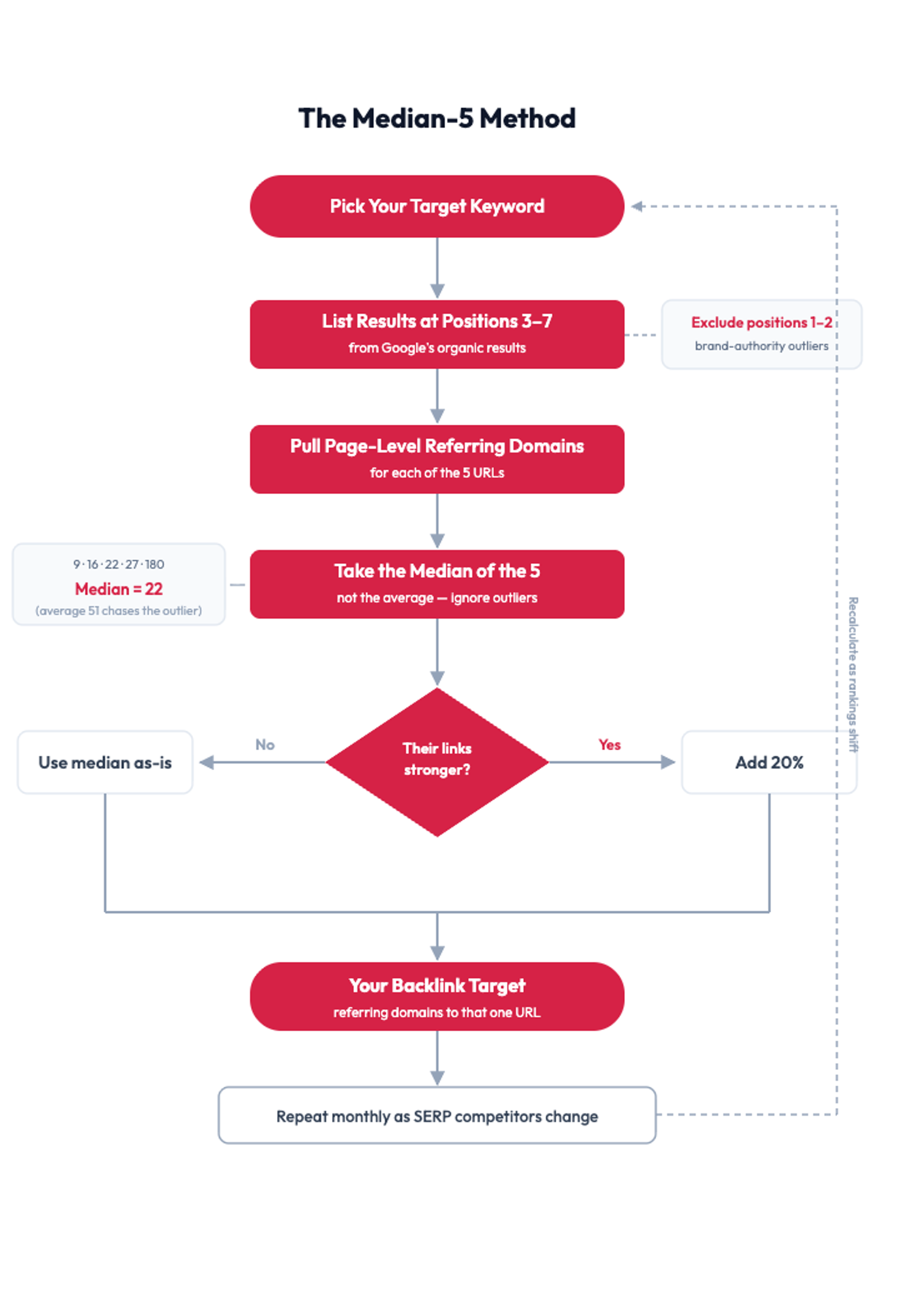
Positions 1 and 2 get dropped deliberately, and this is where SAASY LINKS parts company with most link building advice. On commercial SERPs those two slots usually belong to a brand ranking on domain authority, an aged page with a decade of accumulated links, or a site Google trusts for reasons that have nothing to do with the page itself. Copying their link count sets a target you don't need and can't afford. Positions 3 through 7 are the realistic beachhead, and that's where the honest benchmark lives.
Step 1: Pull the pages at positions 3 through 7
Search your target keyword in an incognito window and list the five organic URLs at positions 3, 4, 5, 6, and 7. Skip Reddit threads, Quora pages, YouTube videos, and anything on a domain you'd never compete with directly. If skipping leaves you short, extend down to position 9 until you have five real content pages.
Then run each URL through a backlink tool at the page level. Ahrefs calls this Referring Domains on the URL setting. Semrush and Moz have equivalents. Write down five numbers.
Step 2: Take the median, not the average
Sort your five numbers and take the middle one. Averages get wrecked by a single outlier, and link profiles almost always contain one.
Take a real set: 9, 16, 22, 27, and 180 referring domains. The average is 51. The median is 22. Chase the average and you've built 29 extra links to match one anomaly that got there through a press cycle you can't replicate. The median tells you what a normal page in that neighbourhood actually carries.
That median is your entry target. Hit it and your page has the link profile of a page already ranking in the range you're aiming for.
Step 3: Apply the quality adjustment
Open the referring domains for the median page and look at where the links come from. If most sit in the DR 50 to 70 range on editorial placements and you're realistically going to earn DR 20 to 40 directory and roundup links, add 20% to your target. If your links will be stronger than theirs, subtract 20%.
One DR 70 editorial link from a relevant publication does the work of roughly five DR 30 links. That ratio isn't precise, and anyone quoting it to two decimal places is guessing. But it's directionally right often enough to plan against, and it's the reason two sites with identical link counts can sit twenty positions apart.
Worked example: a mid-competition SaaS keyword
Say you're targeting a comparison keyword doing 1,200 searches a month in the project management category. The five URLs at positions 3 through 7 carry the numbers from Step 2: 9, 16, 22, 27, and 180 page-level referring domains.
Median: 22. Their links skew toward DR 40 to 60 editorial mentions and you'll be earning similar placements, so no adjustment applies. Your target is 22 referring domains to that single URL.
Twenty-two. Not 907, and not the 300 to 500 you'll see quoted in other guides on this exact keyword. That's the difference between a nine-month campaign and a three-year one, and it's why the calculation is worth doing before the budget gets signed.
The pattern holds in practice. One DR 38 project management SaaS client reached position 3 for a 1,300-volume comparison keyword with 24 referring domains pointing at that URL, built over seven months.
How many backlinks a website needs by competition level in 2026
Competition tier predicts your target better than industry does, because a long-tail term in finance is often easier than a head term in project management. The ranges below are SAASY LINKS planning estimates drawn from mid-market B2B SaaS SERPs rather than figures from a published study, and they're page-level referring domains in every row.
Backlink targets by competition level (SAASY LINKS planning ranges, 2026)
| Competition tier | Keyword profile | Page-level referring domains | Realistic timeline |
|---|---|---|---|
| Low | Long-tail informational, under 200/mo | 0-10 | 1-3 months |
| Medium-low | Informational, 200-800/mo | 10-25 | 3-6 months |
| Medium | Commercial comparison, 800-2,000/mo | 15-40 | 6-12 months |
| High | Category head terms, 2,000-10,000/mo | 40-120 | 12-24 months |
| Very high | Broad finance, insurance, legal | 300-3,000+ | 24 months+ |
Use these as a sanity check on your Median-5 number rather than a replacement for it. If the calculation returns 200 for a keyword doing 300 searches a month, you've almost certainly left a brand outlier in the sample that Step 1 should have filtered out.
Search volume is the weakest signal in the table, incidentally. A 400-volume term like "best hipaa compliant crm" can demand more links than a 4,000-volume term like "crm software" for a niche vendor, because the first attracts every funded competitor in healthcare SaaS while the second is conceded to Salesforce and HubSpot before you start. Read the SERP, not the volume column.
How many backlinks SaaS pages need by page type
Different pages on the same domain need wildly different numbers, and spreading links evenly across all of them wastes most of the budget. A B2B SaaS site needs four separate targets, because its pages compete in four different link environments.
Your homepage
Most SaaS homepages need 40 to 80 referring domains to establish enough site-wide authority for inner pages to rank on modest link counts of their own. Past roughly 80, extra homepage links stop earning their cost, and SAASY LINKS would move that budget to comparison pages every time. Brand mentions, podcast appearances, and funding coverage tend to land on the homepage naturally, so this is the target you're least likely to have to chase.
Pricing and product pages
These rarely need direct links at all. Ten to 20 referring domains is plenty, and most of the authority they need arrives through internal linking from your blog. Pricing pages are also very hard to build links to, because nobody cites a pricing page in an article. Forcing it is one of the more common budget sinks in SaaS SEO, and the fix is usually internal links rather than outreach.
Comparison and alternative pages
Your "X vs Y" and "best X alternatives" pages are the ones worth funding. They convert, they're winnable, and they usually need 15 to 40 page-level referring domains. Because these pages sit closest to a buying decision, a link that moves one into the top three pays back faster than anything else on the site. This is where SaaS link building budget produces the clearest return, and where most SaaS teams underinvest.
Blog content
Informational posts need the fewest links and attract the most on their own. Five to 25 referring domains covers most of them, and original data, calculators, or research pulls that in without outreach. Posts that earn links passively also feed authority to your money pages through internal links, which is the cheapest link building available to you. And it compounds, because every new post adds another internal link source.
How many backlinks per day is safe?
There's no daily limit that triggers a penalty. Google's systems evaluate link quality and relevance rather than counting arrivals per day, and natural link acquisition is lumpy anyway. A product launch or a funding round can bring 40 links in a single week without causing a problem.
What actually causes trouble is a pattern that looks purchased: 30 links a day from unrelated sites, identical exact-match anchor text, and no corresponding brand activity to explain the spike. And the risk for most sites isn't a manual penalty. It's that Google quietly discounts the links, so you pay for 500 and get credit for 30. The money disappears without any warning in Search Console.
How many backlinks per month should you build
Four to 15 new referring domains a month suits most B2B SaaS companies. That sits below the 15 to 101 monthly range WebFX recorded across competitive verticals, which is the right place to be unless you're chasing a head term. Authority Hacker surveyed 755 link builders and found 73.5% build fewer than 10 links a month, so a modest pace puts you in normal company rather than behind it.
Consistency beats volume. Twelve months at five links a month builds a more durable profile than two months at 30, and it costs roughly the same. Worth checking how much link building costs before committing to a monthly number, because the pace you can sustain for a year matters more than the pace you'd like to hit in a quarter.
How many backlinks it takes to get cited by AI search in 2026
There's no citation threshold to hit, but the correlation data points in one clear direction. OppAlerts analyzed roughly 167,000 domains across 100 industries and measured 18 technical signals against citations from 13 AI models. Links dominated the results, with seven of the top 10 signals being link or authority related.
The strongest single factor was search engine outbound links at a correlation of +0.331, meaning pages that already rank in traditional search get cited by AI models far more often than pages that don't. Domain backlinks came in at +0.160. What that means for planning: the referring domains you build to rank in Google are the same ones buying you visibility in ChatGPT and Perplexity. You don't need a second link target for AI.
One finding in that data genuinely surprised us. Reddit comments correlated at +0.148, ahead of Wikipedia citations at +0.055. Presence in discussion threads appears to matter more to AI models than an encyclopedia entry does, which inverts a decade of received wisdom about authority signals. Teams working on AI SEO for SaaS should weight community presence accordingly.
When fewer backlinks will do
Plenty of pages rank on almost nothing. Long-tail keywords under 200 searches a month with informational intent frequently rank on zero page-level links, carried entirely by domain authority and internal links. If your Median-5 calculation returns a number under five, believe it and skip link building on that page entirely.
Three other situations lower the bar. A fresh angle on a topic where every ranking page is three years stale. A branded or navigational query where you're the entity being searched for. Content with unique data that journalists cite on its own, where links arrive as a consequence of publishing rather than something you buy.
Internal links do more work here than most teams credit them for. A page sitting three clicks from your homepage with two internal links pointing at it is starting from a much weaker position than the same page with fifteen, and fixing that costs nothing but an afternoon. Before you approve a link building budget for any URL, check what your own site is already telling Google about that page. Plenty of pages that look like they need external links just need better internal ones.
Five ways the backlink count gets you nowhere
Hitting your number and still not ranking happens often enough that it's worth naming what goes wrong.
Building to the domain instead of the page is the biggest one. Teams celebrate a rising domain rating while the target URL sits at three referring domains and position 34.
Counting total backlinks rather than referring domains inflates your progress on paper. Fifty links from one partner site reads as 50 in a dashboard and functions as one.
Copying the position-1 result sets a target inflated by a brand you aren't competing with on equal terms, which is exactly what the Median-5 Method exists to prevent.
Buying volume from link packages produces the profile Ahrefs documented: 200-plus referring domains and zero search traffic. Relevance does the work in a link profile, and cheap packages sell the one thing that doesn't matter.
Ignoring the content gap sends links to a page that doesn't deserve to rank yet. If the pages above you answer the query better, more links postpone the problem rather than solving it. Fix the page, then count domains. Tracking what actually lands is easier with backlink monitoring tools than with a spreadsheet nobody updates.
How long before new backlinks move rankings
Expect eight to 12 weeks before a new link's full effect shows up in rankings, with movement sometimes visible inside three weeks on low-competition terms. Google has to crawl the linking page, index it, then recalculate. None of those steps happen on a schedule you control.
Two factors stretch that timeline. Links placed on pages that rarely get crawled can sit undiscovered for months, which is a real argument for paying more for placements on active sites. And competitive keywords take longer because your gains have to overcome what competitors are building at the same time, which is the part most forecasts quietly leave out.
This is also why judging a campaign at the 90-day mark misleads almost everyone. Links built in month one are barely counted by month three, and the ones from month three haven't been crawled yet. The honest review point for a link building program is month six, and anyone promising ranking movement inside eight weeks is either targeting keywords that needed no links or selling you something.
Rankings are the lagging indicator anyway. What moves first is the referring domain count on the target URL, then impressions in Search Console, then average position, then clicks. If the first two are climbing and the last two aren't yet, the campaign is working and the calendar hasn't caught up. If referring domains are climbing and impressions are flat after four months, the problem is the page rather than the link count, and building more of them won't fix it.
Frequently Asked Questions
How many backlinks do I need to rank on the first page of Google?
Take the median page-level referring domains of the results at positions 3 through 7 for your keyword. For most mid-competition B2B SaaS terms that's 15 to 60 referring domains. Broad commercial keywords in finance or insurance run into the thousands.
How many backlinks should a website have?
There's no fixed number for a website, because Google ranks individual pages rather than whole sites. Most B2B SaaS homepages need 40 to 80 referring domains for healthy site-wide authority. Inner pages need their own separate targets.
How many high quality backlinks do I need?
Fewer than you'd need at low quality, which is the whole argument for buying quality. One DR 70 editorial link does the work of roughly five DR 30 links, so a target of 22 referring domains can be met with five or six strong placements. Quality changes the count, not just the outcome.
Is 100 backlinks a lot?
For a single page, 100 referring domains is well above average and enough to compete for most mid-competition keywords. If it's 100 individual links from 12 domains, that's a much weaker profile than the number suggests. Count domains, not links.
How many backlinks per day is safe?
There's no daily threshold that triggers a penalty, and natural link growth is uneven by nature. Risk comes from patterns that look bought, like dozens of daily links from unrelated sites using identical anchor text. Google usually discounts those links rather than penalizing the site.
Can you rank without any backlinks?
Yes, on long-tail informational keywords under roughly 200 monthly searches, where domain authority and internal linking carry the page. Commercial and comparison keywords almost always need links. Run the Median-5 calculation to find out which situation you're in.
Do more backlinks always mean better rankings?
No. Ahrefs found nearly 70,000 pages with over 200 referring domains that get zero search traffic. Relevance, page quality, and search intent decide whether links convert into rankings.
How many backlinks do I need to get cited by ChatGPT or Perplexity?
There's no citation threshold, but OppAlerts found seven of the top 10 AI visibility signals are link or authority related. Ranking in traditional search correlated most strongly at +0.331, so the links that earn Google rankings also earn AI citations.

Written by
Co-founder & CEO of SAASY LINKS, the B2B SaaS link building and AI visibility agency. 10+ years in SEO and growth marketing for SaaS brands. Mentor at 500 Startups and Techstars. Runs the Backlink Masterminds community for link builders.
Get Your SaaS Ranked on Google & Cited by AI
Senior-led AI SEO combining strategy, content, editorial links, and AI optimization in 90-day sprints. Built exclusively for B2B SaaS.
Book a Free Consultation CallBuilt exclusively for SaaS.