SaaS SEO Strategy: 8 Steps That Drive Pipeline (2026)

TL;DR
SaaS SEO strategy in 2026 demands a different playbook than traditional SEO. Longer sales cycles, technical buyers, and free-trial funnels change how you prioritize keywords and content. This post walks through 8 steps: funnel-mapped keyword research, product-led content, comparison pages, link building, AI search optimization, topical clusters, community signals, and revenue-tied metrics. BOFU content converts at 4.7x the rate of TOFU blog posts. Link building campaigns deliver 702% ROI for SaaS. Start with comparison and alternative pages — they're closest to revenue.
Free Playbook
The exact 90-day playbook we run for clients

Why SaaS SEO Is Different from Traditional SEO
SaaS SEO targets buyers who research for weeks before signing up for a free trial — and months before converting to paid. That's fundamentally different from e-commerce SEO (buy now) or local SEO (visit today). The average B2B SaaS sales cycle runs 3-6 months, which means your SEO strategy needs content at every stage of the funnel, not just top-of-funnel blog posts. Ahrefs' research confirms it takes 3-6 months to see results for competitive keywords — and SaaS keywords tend to be competitive. Our off-page SEO checklist covers the authority-building side of this equation.
Four things make SaaS SEO strategy distinct: (1) your product IS the conversion — there's no physical product to ship, so the website does the selling; (2) free trials and freemium models create a middle funnel that most industries don't have; (3) your buyers are technical decision-makers who search differently than consumers; and (4) product-led growth means your product pages are SEO assets, not just marketing pages.
The SaaS SEO Growth Loop
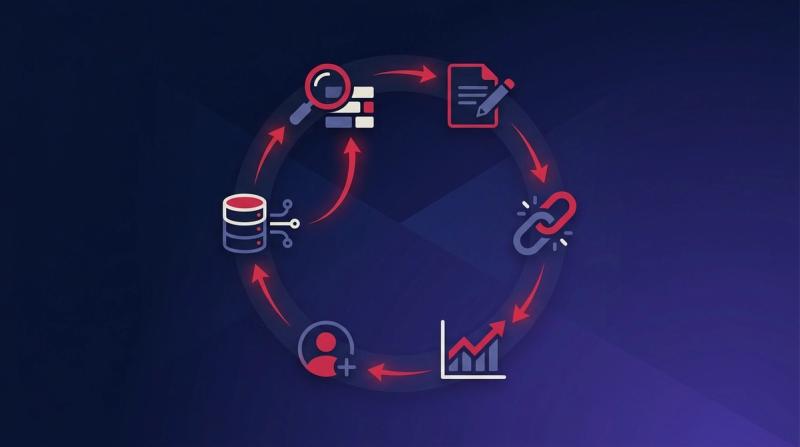
Most SaaS companies treat SEO as a linear project: research keywords, write content, build links, wait. That approach plateaus. The SaaS SEO Growth Loop is a compounding model where each cycle feeds the next.
Here's how it works. You start with keyword research tied to your ICP's pain points. You create product-led content that addresses those pain points while showing your product as the solution. You build links to those pages to earn rankings. Rankings drive signups. Signups generate customer data — support tickets, feature requests, onboarding questions — that reveals new keywords your ICP actually uses. Those keywords feed the next round of content. And the loop accelerates.
The companies that compound fastest — Ahrefs, HubSpot, Notion — all run some version of this loop. They don't outsource keyword research to a generic tool. They mine their own customer conversations for the exact language their buyers use.
8 Steps to Build a SaaS SEO Strategy in 2026
These steps follow the Growth Loop. Each one builds on the previous.
1. Map Keywords to Your Funnel (TOFU / MOFU / BOFU)
SaaS keyword research isn't about finding the highest-volume terms. It's about mapping keywords to where your buyer is in the decision process. A TOFU keyword like "what is project management" attracts browsers. A BOFU keyword like "Monday.com vs Asana" attracts buyers. Most SaaS companies over-invest in TOFU and starve BOFU — which is why their traffic grows but pipeline doesn't. We wrote a full breakdown of bottom-of-funnel keywords for SaaS.
“You create all this content and theoretical rankings, but no one googles those terms when they're ready to buy, so they don't find anything, and they don't convert.”
Targeting keywords your product doesn't solve is one of the most common SaaS SEO mistakes. Ranking for "what is CRM" when you sell email marketing tools drives traffic that never converts. Match keywords to product-market fit, not just volume.
2. Build Product-Led Content Pages
Product-led content weaves your product into the answer to the reader's question. Instead of a generic "how to track backlinks" post, Ahrefs shows you how to track backlinks using Ahrefs — with real screenshots and workflows. The content is genuinely useful even if you don't buy, but the product is so embedded in the solution that signing up feels natural.
This works because SaaS products ARE the solution to the search query. If someone searches "how to monitor brand mentions," showing them how to do it with your tool is more valuable than a generic list of tactics. The page ranks because it's useful, and it converts because it demonstrates the product.
3. Create Comparison and Alternative Pages
Comparison pages ("Your Product vs Competitor") and alternative pages ("Top [Competitor] Alternatives") are the highest-converting content type in SaaS SEO. SAASY LINKS' analysis of 90 SaaS content marketing campaigns found that BOFU content — comparison pages, alternative pages — converts at 4.7x the rate of TOFU blog posts. These searchers have already decided they need a solution. They're choosing which one.
BOFU content should make up at least 40% of any SaaS content calendar. Most agencies over-invest in TOFU and wonder why traffic doesn't convert. Writing only TOFU content and expecting pipeline is a pattern we see constantly — SaaS companies that invest 80%+ in TOFU see high bounce rates and low conversion because the content attracts people who aren't buying.
4. Invest in Link Building Early
SaaS companies that wait until "the content is ready" to build links lose 6-12 months of compounding. Link building campaigns deliver an average 702% ROI for SaaS companies, according to FirstPageSage's 2024 study. Start building editorial backlinks to your highest-priority pages as soon as they're published — don't wait for them to rank organically first. A SaaS link building agency can accelerate this, but even in-house teams should dedicate 20-30% of their SEO budget to link acquisition from day one.
One agency partner switched to our link building program and saw their client portfolio's average organic traffic grow 34% within 6 months. They retained 3 accounts worth $18K/month combined that were previously churning — because the SEO results gave clients a reason to stay.
5. Optimize for AI Search Visibility
94% of B2B buying groups now use large language models during their purchase journey. That means your SaaS SEO strategy needs to account for ChatGPT, Perplexity, and Google AI Overviews — not just traditional organic results. An OppAlerts study of 167,000 domains found that topical relevance on your homepage — measured by keyword alignment — is the second strongest AI visibility signal (+0.204). Our AI SEO guide covers the full playbook.
For SaaS specifically, this means your product pages, comparison pages, and BOFU content need to be structured so AI models can extract clean answers. Lead each section with a direct answer. Include specific numbers, pricing, and feature details. And make sure your homepage clearly communicates what your product does and who it's for — that homepage signal feeds AI recommendations.
6. Build Topical Authority with Content Clusters
Content clusters group related pages around a central hub page, connected by internal links. Instead of publishing 50 disconnected blog posts, you build 4-5 clusters of 10-15 posts each. Google rewards this structure because it demonstrates topical depth — you're not just covering a keyword, you're covering an entire subject.
For a SaaS company, clusters should map to your product's core value propositions. An analytics SaaS might have clusters around "marketing attribution," "data visualization," and "reporting dashboards." Each cluster has its own hub page targeting the highest-volume keyword, with spokes targeting long-tail variants. Our SEO content strategy guide walks through how to plan and prioritize these clusters.
7. Use Community Signals (Reddit, Slack, G2)
Reddit threads, G2 reviews, and Slack community discussions are off-page signals that most SaaS SEO strategies ignore entirely. But they matter — Reddit comments correlate with AI visibility nearly 3x more than Wikipedia citations. And Google increasingly surfaces Reddit threads directly in SERPs for SaaS-related queries.
The tactic is straightforward: show up where your buyers discuss problems. Answer questions on r/SaaS, r/startups, and niche subreddits for your vertical. Don't promote — just help. Over time, your brand becomes the name people mention when someone asks for recommendations. A Reddit marketing agency can help scale this, but authenticity is non-negotiable. Redditors detect promotional content instantly.
8. Track SEO Metrics That Map to Revenue
Traffic is a vanity metric for SaaS. What matters is whether organic search drives signups, qualified leads, and pipeline. Track these metrics monthly and tie every SEO initiative back to revenue impact. If you can't draw a line from a blog post to a demo request, the post isn't doing its job.
Step zero is knowing where you stand. A structured SEO audit for B2B scores your technical health, content quality, and backlink profile so every step in this strategy targets the gaps that actually matter.
SaaS SEO Metrics That Actually Matter in 2026
Most SaaS companies track rankings and traffic. That's necessary but not sufficient. Here are the metrics that connect SEO to business outcomes:
If you're building a SaaS SEO strategy from scratch and want help with the execution — from keyword research to link building to AI visibility — our SaaS SEO agency works with B2B SaaS companies at every stage.
Frequently Asked Questions
What is a SaaS SEO strategy?
A SaaS SEO strategy is a plan to drive organic traffic and signups for a software-as-a-service product. It differs from traditional SEO by focusing on product-led content, comparison pages, and funnel-mapped keyword research that ties organic search to pipeline and revenue.
How long does it take for SaaS SEO to show results?
Expect 3-6 months for competitive keywords and 4-8 weeks for low-competition long-tail terms. Link building accelerates this timeline. Companies that invest in editorial backlinks from day one typically see results 30-40% faster than those relying on content alone.
What's the best keyword strategy for SaaS companies?
Map keywords to your sales funnel: TOFU for awareness, MOFU for consideration (product-led content), BOFU for decision (comparison and alternative pages). Prioritize BOFU keywords first — they convert at 4.7x the rate of TOFU content and produce pipeline faster.
How is SaaS SEO different from traditional SEO?
SaaS SEO targets longer sales cycles (3-6 months vs minutes), technical buyers who research extensively, and free-trial conversion funnels. The content strategy emphasizes product-led pages and comparison content over generic informational posts.
Should SaaS companies prioritize content or link building?
Both, simultaneously. Content without links won't rank for competitive terms. Links without content give search engines nothing to rank. Start link building as soon as your first priority pages are published — don't wait for organic traction before investing in authority.
What ROI can SaaS companies expect from SEO?
FirstPageSage's 2024 study found that link building campaigns deliver an average 702% ROI for B2B SaaS companies with a break-even time of 7 months. Organic search also compounds — unlike paid ads, SEO traffic doesn't disappear when you stop spending.
Does AI search matter for SaaS SEO in 2026?
Yes. 94% of B2B buying groups now use LLMs during their purchase journey. SaaS companies that optimize for AI search visibility — through brand mentions, editorial backlinks, and structured content — appear in ChatGPT and Perplexity recommendations alongside Google results.

Written by
Co-founder & CEO of SAASY LINKS, the B2B SaaS link building and AI visibility agency. 10+ years in SEO and growth marketing for SaaS brands. Mentor at 500 Startups and Techstars. Runs the Backlink Masterminds community for link builders.
Get Your SaaS Ranked on Google & Cited by AI
Senior-led AI SEO combining strategy, content, editorial links, and AI optimization in 90-day sprints. Built exclusively for B2B SaaS.
Book a Free Consultation CallBuilt exclusively for SaaS.