Link Building Guide: Proven Tactics for 2026


TL;DR
Link building in 2026 comes down to quality over volume. Eight tactics consistently work: guest posting, niche edits, broken link building, resource pages, digital PR, brand mentions, listicle placements, and competitor analysis. The Authority Stack Model gives you a progression from easy foundation links to hard-to-earn editorial placements. Average cost per link is $361, but ranges from $100 for niche edits to $2,000+ for digital PR. Two mistakes kill ROI faster than anything: building links only to the homepage and relying on HARO. Track referring domains weekly, DR monthly, and AI citations quarterly.
Free Playbook
The exact 90-day playbook we run for clients

According to Authority Hacker's 2024 survey, 65% of marketers say link building is the hardest part of SEO. That percentage hasn't dropped. The tactics have shifted, costs have climbed, and Google's algorithm now shares the stage with ChatGPT, Perplexity, and Gemini — but backlinks still determine who ranks and who doesn't.
This guide covers every link building tactic worth your time in 2026, backed by data and campaign results from over 1,200 placements for B2B SaaS companies. Whether you're running your first outreach campaign or managing link building at scale, you'll find the methods, costs, and mistakes that matter right now.
“Link building isn't really link building. It's relationship building.”
What Is Link Building?
Link building is the practice of getting other websites to link back to your pages. Each backlink acts as a vote of confidence — Google and other search engines use these votes to decide which pages deserve to rank higher. In 2026, backlinks do more than influence Google. They also affect whether AI platforms like ChatGPT and Perplexity mention your brand.
The core idea hasn't changed since Google's founders published their PageRank paper in 1998. More quality links from relevant, authoritative sites push your pages up in search results. What's changed is how you earn those links and what counts as quality.
Why Link Building Still Matters in 2026
Backlinks remain one of the three strongest ranking factors in Google's algorithm, and they now directly influence AI search visibility. A Backlinko study of 11.8 million search results found that pages ranking #1 average 847 referring domains, compared to 197 for pages in position 5 and below — a 4.3x gap that hasn't narrowed. Two separate systems now reward backlinks: traditional search engines and AI citation engines.
Search Rankings
Google still treats backlinks as editorial endorsements. Pages with more high-quality referring domains rank higher for competitive keywords, earn featured snippets more often, and hold their positions longer during algorithm updates. SAASY LINKS tracks link building statistics across dozens of campaigns, and the correlation between referring domain count and organic traffic growth is consistent. Not linear — but undeniable.
AI Visibility
An OppAlerts study of ~167,000 domains across 13 AI models found that Domain PageRank — a direct measure of link authority — correlates at +0.192 with AI search visibility. That makes it the third-strongest signal out of 18 factors analyzed. Links don't just help you rank in Google anymore. They help ChatGPT, Perplexity, and Gemini decide whether to cite your brand.
SAASY LINKS built 23 editorial backlinks (avg DR 61) for an email marketing SaaS over 3 months. The client's AI citation count went from 1 (Perplexity only) to 9 across 4 AI platforms.
What Makes a Good Backlink?
Not all backlinks carry equal weight. A single link from a relevant, high-authority publication can move your rankings more than 50 links from obscure directories. Google evaluates four primary factors when assessing a backlink's value: the linking site's authority, topical relevance, anchor text, and where on the page the link sits.
Authority
Authority measures how much trust and link equity a website has built over time. Tools like Ahrefs and Moz score this as Domain Rating (DR) or Domain Authority (DA). Higher authority means more ranking power passed through the link. But here's where most people get it wrong: DR is a vanity metric when it comes to link quality. A DR 35 niche blog with 5,000 monthly visitors in your exact vertical is worth more than a DR 70 general news site that nobody in your market reads. Traffic, topical match, and editorial standards matter more than a number in a third-party toolbar. The question of how many backlinks you actually need depends more on quality than quantity.
Relevance
A backlink from a site in your industry carries more weight than one from an unrelated domain. Google's algorithms identify topical connections between the linking page, the linking site, and your page's content. A cybersecurity SaaS getting a link from a cybersecurity publication sends a clear topical signal. That same company getting a link from a cooking blog sends none. Relevance extends to the content surrounding the link. A mention within a paragraph about your exact topic passes more contextual signal than a link buried in a sidebar or footer. SAASY LINKS prioritizes placements where the link sits inside relevant editorial content — on pages with real traffic from readers who care about the topic.
Anchor Text
Anchor text is the clickable text of a link. Google uses it to understand what the linked page is about. Exact-match anchors (using your target keyword as the anchor) send the strongest relevance signal, but overusing them triggers penalties. The pattern that works in 2026: ~10% exact match, ~30% partial match, ~35% branded, and ~25% generic or natural phrases.
Link Placement
Links embedded within the main body content carry more weight than links in footers, sidebars, or author bios. Google's reasonable surfer model assigns higher click probability — and more ranking value — to links that appear within the editorial flow of a page. A contextual link in the first few paragraphs of an article passes more equity than the same link at the bottom of a resource list.
Link Building Strategies That Work in 2026
Eight tactics consistently produce results for B2B companies in 2026. Each works differently — some scale easily, others take time but produce stronger links. SAASY LINKS has tested all of them across hundreds of SaaS link building campaigns, and the tactics below are ordered by the combination of link quality and repeatability.
Guest Posting
Publishing original content on another site's blog, with a contextual link back to your site, remains one of the most reliable methods. The catch: Adsy's analysis of 52,671 websites found that 85.3% of sites accepting guest posts are low quality — DR under 40 with less than 10K monthly traffic. Vetting the publication before writing matters more than the writing itself. SAASY LINKS covers the full process in a dedicated guide to SERP-informed guest posting.
Niche Edits and Link Insertions
Instead of writing new content, niche edits place your link within an existing published article. The page already has age, authority, and rankings — your link inherits those signals immediately. SAASY LINKS' niche edit campaigns average a 22-day turnaround from prospecting to live placement, compared to 45+ days for guest post campaigns. The tradeoff: you can't control the surrounding content as tightly. And you should understand the differences between link insertions and guest posts before picking a method.
Broken Link Building
Find pages linking to dead URLs (404s) on sites in your niche, create content that replaces what was there, and pitch the webmaster to swap the broken link for yours. It works because you're solving a problem — nobody wants broken links on their site. The method isn't fast. Finding relevant broken links at scale requires tools like Ahrefs or Screaming Frog, and response rates hover around 5-10%. But the links you do land tend to be high quality, since you're replacing content on established pages.
Resource Page Link Building
Resource pages curate links to useful tools, guides, and references within a topic. Getting listed on a well-maintained resource page puts your link in front of a targeted audience and passes genuine editorial authority. Search for resource pages using queries like "your keyword + resources" or "your keyword + useful links." Quality varies wildly — the best resource pages have real traffic and selective inclusion criteria.
Digital PR and Linkable Assets
Creating data studies, original research, interactive tools, or guides that journalists and bloggers want to reference produces links that compound over time. A single data study can earn dozens of organic backlinks without active outreach — if the data is genuinely new and useful. The investment is higher than other tactics. Producing original research takes weeks, not days. But the link quality and natural anchor text distribution are hard to match with any other method. SAASY LINKS breaks down the differences between link building and digital PR in a separate guide.
Unlinked Brand Mentions
When someone mentions your brand online without linking to you, that's an unlinked mention — and it's a link opportunity hiding in plain sight. Tools like Ahrefs, Brand24, and Google Alerts can surface these mentions, and a simple outreach email asking for the link converts at higher rates than cold pitches. SAASY LINKS placed 1,400+ editorial brand mentions across 38 client campaigns in 2025, with a 23% conversion rate from unlinked to linked mentions. The full process, including outreach templates and tool comparisons, is in the unlinked brand mentions guide.
Listicle Placements
Getting your product or service featured in "best of" listicles drives both referral traffic and backlinks. Tim Soulo's Ahrefs research found that 43.8% of all AI chatbot citations come from "best X" listicles — making them the single most cited content format. A listicle placement puts your brand in front of AI engines that pull from these pages. SAASY LINKS explains how listicle placements work and lists the top listicle link building agencies worth considering.
Competitor Backlink Analysis
Studying where your competitors get their links reveals repeatable opportunities. If a competitor has 30 links from guest posts on SaaS blogs, those same blogs likely accept guest contributions from you. Tools like Ahrefs Site Explorer let you filter competitor backlinks by type, authority, and recency — so you focus on links that are both valuable and gettable.
Link Building Tactics Comparison (2026)
| Tactic | Difficulty | Avg Cost/Link | Time to Results | Link Quality | Scalability |
|---|---|---|---|---|---|
| Guest Posting | Medium | $200–$500 | 4–8 weeks | Medium-High | Medium |
| Niche Edits | Low-Medium | $150–$400 | 2–4 weeks | Medium | High |
| Broken Link Building | Medium | $100–$300 (time) | 6–12 weeks | High | Low |
| Digital PR | High | $500–$2,000+ | 8–16 weeks | Very High | Low |
| Resource Pages | Low | $50–$200 (time) | 4–8 weeks | Medium | Medium |
| Listicle Placements | Medium | $200–$600 | 2–6 weeks | Medium-High | Medium |
| Brand Mentions | Low | $100–$300 | 2–4 weeks | Medium | High |
How to Build Backlinks Step by Step
The Authority Stack Model gives you a four-layer progression from easy, low-impact links to hard, high-impact links. Most companies start at Layer 1 and never graduate — which is why most companies never rank for competitive terms.
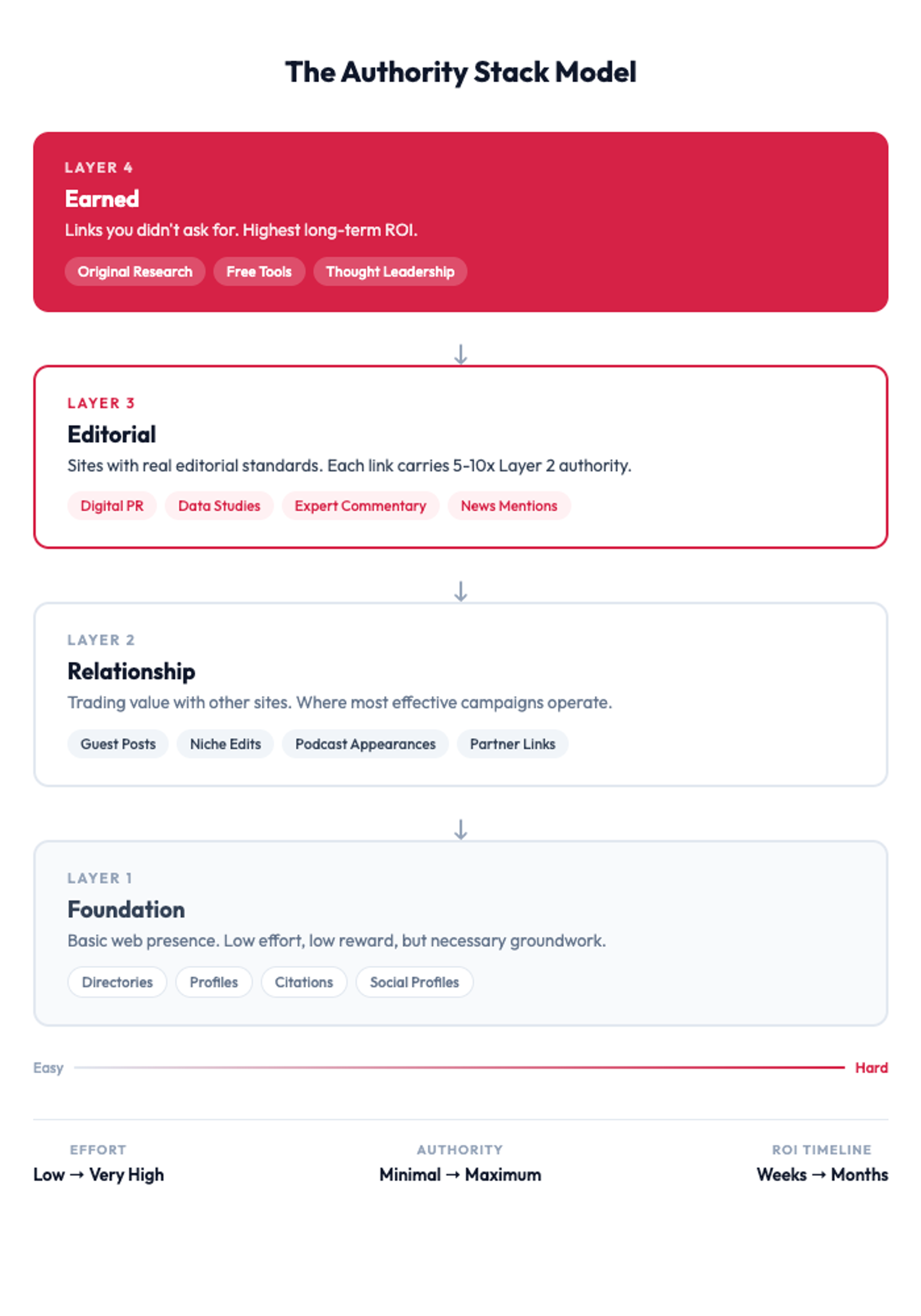
Layer 1 — Foundation. Directory listings, industry profiles, business citations. These won't move rankings on their own, but they establish your site's basic presence across the web. Think Google Business Profile, Crunchbase, Product Hunt. Low effort, low reward, but necessary groundwork.
Layer 2 — Relationship. Guest posts, niche edits, podcast appearances, partner cross-links. You're trading value with other sites — your content or expertise for their link. This is where most effective campaigns operate day-to-day. Medium effort, solid results.
Layer 3 — Editorial. Digital PR placements, data studies cited by journalists, expert commentary in news articles. These links come from sites with real editorial standards and real audiences. SAASY LINKS delivers editorial links from publications with an average DR of 62 across 1,200+ placements in 2025-2026. Higher effort, but each link carries 5-10x the authority of a Layer 2 link.
Layer 4 — Earned. Links you didn't ask for. Original research that gets cited organically. Free tools that people link to because they're genuinely useful. Thought leadership content that bloggers reference without prompting. Hardest to manufacture, highest long-term ROI.
The full link building checklist walks through each layer with action items you can start this week.
Link Building for Different Business Types
The right link building mix depends on your market, budget, and growth stage. A bootstrapped startup and a Series C SaaS company need fundamentally different approaches — not because the tactics differ, but because the volume, speed, and risk tolerance change.
SaaS Companies
SaaS companies benefit most from editorial links on industry blogs, listicle placements for competitive keywords, and data-driven content that earns organic backlinks. The competitive landscape is intense — most SaaS keywords require 50+ referring domains to crack the top 5. SAASY LINKS details approaches specific to SaaS in the full SaaS link building guide.
Startups
Startups with limited budgets should prioritize high-ROI tactics: founder-led PR (get interviewed on podcasts and industry blogs), unlinked mention reclamation, and competitor backlink replication. Avoid expensive digital PR campaigns until you've confirmed product-market fit. The startup link building guide covers tactics for companies with under 50 referring domains.
B2B Companies
B2B link building lives and dies by industry relevance. A link from a general tech blog helps, but a link from the publication your buyers actually read moves deals. Trade publications, industry reports, and expert roundups in your vertical are worth 10x what generic guest posts deliver. SAASY LINKS breaks down B2B-specific tactics in a dedicated B2B link building guide.
How Much Does Link Building Cost?
Authority Hacker's 2024 survey puts the average cost of a link placement at $361, with a range of $100 to $1,000+ depending on the site's authority and editorial standards. But averages hide the real picture. A niche edit on a DR 30 blog might cost $150. An editorial placement in a DR 75 publication runs $800+. And digital PR campaigns that generate dozens of organic links can cost $3,000-$10,000 per project.
SAASY LINKS published a full link building cost breakdown with pricing data from across the industry — including what you should expect to pay for guest posts, niche edits, editorial links, and agency retainers.
Should You Outsource Link Building?
Most companies reach a point where in-house outreach hits a ceiling. The work is time-intensive, relationship-dependent, and hard to scale without dedicated staff. If your team spends more than 15 hours per week on outreach and produces fewer than 8 quality links per month, outsourcing will likely deliver better results at lower cost. SAASY LINKS compared outsourced link building and in-house vs outsourced approaches in detail, including scenarios where keeping it in-house is the right call.
For agency owners, white label link building services let you add backlinks to your service offering without hiring. And if you're evaluating agencies for your own company, the best SaaS link building agencies list compares pricing, specialties, and track records.
Link Building Mistakes to Avoid
Two mistakes destroy ROI more than any other: building links only to the homepage, and relying on a single outdated tactic.
Homepage links build domain authority but don't move specific page rankings. You need page-level backlinks to the URLs you actually want to rank. Most agencies default to homepage links because they're easier to pitch — not because they produce results for the pages that matter.
And HARO (now Connectively) used to be a reliable source of journalist links. Not anymore. Response rates have cratered since 2023 as journalists drown in AI-generated pitches. The time-to-link ratio makes it one of the least efficient methods available in 2026. You'll spend 10 hours pitching for one link that might be nofollow.
Other patterns to avoid: buying links from sites that sell guest posts to anyone willing to pay, chasing high-volume informational keywords where you can't outrank Moz and Ahrefs, and accepting "guaranteed link" packages that deliver placements on sites nobody reads. Focus on building powerful backlinks from sites with real traffic and editorial standards instead.
How to Measure Link Building Results
Track four metrics to measure whether your campaigns are working: referring domain growth, Domain Rating trend, organic traffic change on target pages, and AI citation count. The first two confirm you're building links. The second two confirm those links are producing rankings. SAASY LINKS recommends checking referring domains weekly, DR monthly, and running a full backlink audit quarterly. If you're focused on increasing your Domain Rating, that guide walks through the tactics that actually move the needle.
Frequently Asked Questions
What is link building in SEO?
Link building is the process of getting other websites to link to your pages. Search engines treat backlinks as votes of confidence — more quality links from relevant sites mean higher rankings in both Google and AI search platforms.
How many backlinks do I need to rank?
It depends on keyword competition. Backlinko found that #1 results average 847 referring domains. For low-competition keywords, 10-30 quality backlinks can reach page 1. SAASY LINKS covers this in detail in the backlinks-to-rank guide.
Is link building still effective in 2026?
Yes. Links remain one of Google's top ranking factors, and Domain PageRank is the third-strongest signal for AI search visibility according to OppAlerts. Both Google and AI platforms reward sites with strong backlink profiles.
How much should I budget for link building?
Plan for $200-$500 per quality link, or $2,000-$10,000/month for a managed campaign. Costs vary by publication authority and campaign type. Full pricing data is in the link building cost guide.
What's the difference between dofollow and nofollow links?
Dofollow links pass ranking authority (PageRank) to the linked page. Nofollow links include a rel="nofollow" attribute telling search engines not to pass authority. Most campaigns target dofollow links, though nofollow links from high-authority sites like Reddit still carry brand visibility value.
Can I get backlinks for free?
Yes — tactics like broken link building, unlinked mention reclamation, and creating linkable content don't require direct payment. They cost time instead of money. SAASY LINKS compiled a full list of free backlink methods that work without paid outreach.
What are the riskiest link building tactics?
Buying links from PBNs (private blog networks), participating in link schemes, and using automated link building software. Google's algorithms detect these patterns and penalize sites with manual actions or algorithmic demotion. The penalty can take months to recover from — if it's reversible at all.
How long does it take to see results from link building?
Most campaigns show measurable ranking improvements within 8-12 weeks. Competitive keywords take longer — sometimes 4-6 months. Google recrawls and reassesses link signals continuously, but the impact compounds over time rather than arriving all at once.

Written by
Co-founder & CEO of SAASY LINKS, the B2B SaaS link building and AI visibility agency. 10+ years in SEO and growth marketing for SaaS brands. Mentor at 500 Startups and Techstars. Runs the Backlink Masterminds community for link builders.
Get Your SaaS Ranked on Google & Cited by AI
Senior-led AI SEO combining strategy, content, editorial links, and AI optimization in 90-day sprints. Built exclusively for B2B SaaS.
Book a Free Consultation CallBuilt exclusively for SaaS.