SaaS SEO: The Complete 2026 Guide to Organic Pipeline

TL;DR
SaaS SEO is search engine work for software companies, measured in trials, demos and pipeline rather than traffic. It rests on six pillars: technical SEO, on-page SEO, content and keyword research, off-page SEO and links, AI search visibility, and audits and measurement. Buyers research for months and compare four to six vendors, so the pages closest to revenue (comparisons, alternatives, use cases) should get attention first. SAASY LINKS' analysis of 90 SaaS content campaigns found bottom-of-funnel pages convert at 4.7x the rate of top-of-funnel posts. Run the work as a loop: customer language becomes product-led pages, links make them rank, and signups surface the next round of keywords. Track organic signups and AI citations, not just positions, because 94% of B2B buyers now use LLMs during a purchase.
Free Playbook
The exact 90-day playbook we run for clients

B2B software buyers now do most of their research before a salesperson hears from them. The 6sense 2025 Buyer Experience Report surveyed nearly 4,000 B2B buyers and found 94% use large language models during a purchase. What those buyers find on Google and in ChatGPT decides which vendors make the shortlist.
That's the job of SEO for a software company. It has to reach technical buyers early and show up again when they compare tools, then send them to a trial or a demo. Search for business software works differently from consumer search, which is why SEO for B2B companies needs its own playbook in the first place.
This page is our hub for the topic. Each pillar below links to a deeper guide, and the steps show how we'd build the program from zero. Most of it is unglamorous. It works because it compounds.
What Is SaaS SEO?
SaaS SEO is search engine work built for software-as-a-service companies. It covers keyword research, content, links, technical site health and AI search visibility, all measured against subscription revenue. The goal isn't traffic on its own. It's free trial signups, demo requests and pipeline your sales team can close.
Think of it as SEO with a longer memory. A buyer might read your comparison page in March, see your brand in a ChatGPT answer in April and search your name in May. Every one of those touches counts, even though only the last one shows up as a branded visit in analytics.
SaaS SEO vs Traditional SEO
The mechanics are the same: crawlable pages and links from trusted sites. The buyer is different. Software purchases involve committees, free trials and months of comparison, so the content mix shifts toward pages that help someone choose between tools.
SEO for SaaS companies vs traditional SEO
| Factor | SaaS SEO | Traditional SEO |
|---|---|---|
| Sales cycle | Weeks to months (trial, then paid) | Minutes to days |
| Buyer | Technical decision-makers and buying committees | Individual consumers |
| Content priority | Product-led, comparison and alternative pages | Category pages and product descriptions |
| Main conversion | Free trial signup or demo request | Purchase or lead form |
| Keyword intent | Problem-aware, comparing solutions | Product-searching, transactional |
| AI search exposure | High: buyers ask LLMs to compare vendors | Moderate: still Google-led |
Why SaaS Companies Need SEO in 2026
Software companies need SEO because search is where buyers go before they talk to vendors, and the traffic compounds instead of stopping when a budget runs out. BrightEdge research puts organic search at 53% of all website traffic. Paid ads stop the day you cut spend; a ranking page keeps sending trials for years.
The returns are measurable, too. FirstPageSage's 2024 study found link building campaigns deliver an average 702% ROI for B2B SaaS companies, with a break-even point around seven months. That timeline matters when you plan budgets: expect a slow first two quarters, then a curve that bends upward.
And search has spread beyond Google. Buyers now ask ChatGPT, Perplexity and Gemini which tools to shortlist, and those answers lean on the same pages that rank. A company without organic visibility in 2026 isn't just missing clicks. It's missing from the conversation buyers have with AI before they ever visit a vendor site.
The 6 Pillars of SaaS SEO
Six areas make up a complete SEO program for a software company: technical SEO, on-page SEO, content and keyword research, off-page SEO and links, AI search visibility, and audits with measurement. Each one below gets a short summary and a link to our deeper guide, so you can go straight to the part you're working on.
Technical SEO
Technical work decides whether Google and AI crawlers can reach, render and index your pages at all. SaaS sites tend to break it in the same places: JavaScript-heavy marketing pages, docs on a separate platform and parameter URLs on pricing pages. Our technical SEO guide walks through each fix in order, using a five-rung audit model.
On-Page SEO
On-page work makes each page match the search it targets: the title tag, the headings, the first paragraph and the internal links. For software companies, the payoff is biggest on feature, pricing and comparison pages, which often ship with the product team's wording instead of the buyer's. We cover it in detail further down this page.
Content and Keyword Research
Content is where most of the budget goes, and where most of it gets wasted. Start with bottom-of-funnel keywords for SaaS, the terms people type when they're choosing a tool, before writing definitions of your category. Then plan clusters around your product's core use cases with an SEO content strategy that links every post to a hub.
Off-Page SEO and Link Building
Links from sites your buyers already read are still the strongest signal you can earn. Our off-page SEO checklist covers links, brand mentions and reviews together. If you're early stage with a low domain rating, the guide to link building for startups shows which links to go after first.
AI Search Visibility
AI answers pull from pages that rank and from brands that get mentioned on trusted sites. The OppAlerts study of about 167,000 domains found topical relevance on your homepage, measured by keyword alignment, is the second strongest AI visibility signal at +0.204. Our AI SEO guide covers the rest of the playbook.
Audits and Measurement
An audit tells you which pillar is holding the rest back. Our SEO audit for B2B scores technical health, content and backlinks so you can fix the biggest gap first, and the metrics table near the end of this page shows what to report each month.
The SaaS SEO Growth Loop
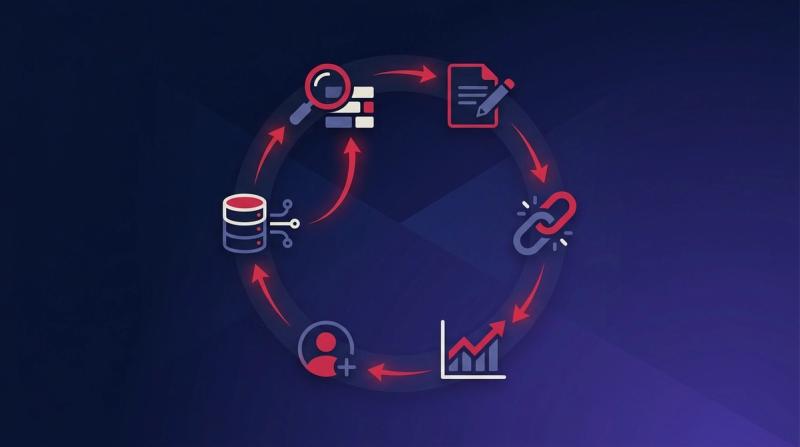
The SaaS SEO Growth Loop is our model for running SEO as a cycle instead of a one-off project. Customer language becomes product-led pages, links make those pages rank, rankings and AI citations bring signups, and signup data surfaces the next set of keywords. Each lap starts with better inputs than the last.

Most software companies run SEO in a straight line: research keywords, write posts, build a few links, wait. That plateaus after 12 to 18 months because the keyword list came from a tool, not from customers. The loop fixes the input. Support tickets and sales calls keep showing you phrases no keyword tool will surface until your competitors already rank for them.
Ahrefs, HubSpot and Notion all run some version of this. They publish content that shows their own product solving the problem, then mine customer conversations for the next topic. The product is part of the answer, which is why their pages convert.
8 Steps to Build a SaaS SEO Strategy in 2026
Build the program in this order: map keywords to the funnel, create product-led pages, add comparison pages, start link building, prepare for AI search, organize content into clusters, add community signals and track revenue metrics. The early steps sit closest to pipeline, so they pay back while the slower work builds up.
1. Map Keywords to Your Funnel and Your ICP
Start with who's buying. Write down your ideal customer profile, the job titles on the buying committee and the problems each person is trying to solve. Then sort keywords into top, middle and bottom of funnel. A term like "what is project management" attracts browsers; "Monday.com vs Asana" attracts buyers. Our guide to bottom-of-funnel keywords covers the buying end in depth.
“You create all this content and theoretical rankings, but no one googles those terms when they're ready to buy, so they don't find anything, and they don't convert.”
2. Build Product-Led Content Pages
Product-led content answers the reader's question with your product inside the answer. Ahrefs doesn't publish a generic "how to track backlinks" post; it shows how to track backlinks in Ahrefs, with real screenshots. The page is useful to someone who never buys, but for anyone who does, signing up feels like the obvious next step.
Four formats work especially well for software. Templates let readers start the job inside your product. Free tools and calculators solve a small version of the problem in a browser tab. Integration pages answer "does it work with X" for buyers who've already decided on a stack. And use-case pages show one team, like finance or support, solving one problem step by step.
Pick the format by the search. If the top results for a keyword are templates, a 2,000-word essay won't outrank them. Check the first page of Google before you brief the writer, and match what's already winning.
3. Create Comparison and Alternative Pages
Comparison pages ("Your Product vs Competitor") and alternative pages ("Best Competitor Alternatives") convert better than anything else a software company publishes. SAASY LINKS' analysis of 90 SaaS content marketing campaigns found bottom-of-funnel content like this converts at 4.7x the rate of top-of-funnel blog posts. These searchers already know they need a tool. They're picking one.
In our view, bottom-of-funnel pages should make up at least 40% of a SaaS content calendar. Most teams sit closer to 10% and then wonder why traffic grows while signups don't.
Write comparison pages for the buyer, not for your sales deck. Say who each tool is best for, including the cases where the competitor wins. Add a pricing table with the real numbers, a feature table that covers the five things buyers ask about most and a short section on switching. Readers trust a page that admits a weakness, and AI answers quote pages that state clear tradeoffs.
Alternative pages need the same honesty at a larger scale. A "best [competitor] alternatives" page that lists your product first and four weak options after it reads as an ad. List eight to 10 real options, rank yourself where you'd put yourself in front of a skeptical customer, and explain the choice.
4. Start Link Building Early
Don't wait for content to rank on its own before building links. Companies that hold off lose six to 12 months of compounding authority. Point editorial links at your highest-priority pages as soon as they're live, and plan on 20% to 30% of the SEO budget going to links from the first month. A SaaS link building agency can speed this up, but in-house teams can start with the tactics further down.
5. Prepare for AI Search Visibility
Structure the pages buyers compare so an AI answer can lift a passage cleanly. Lead each section with a direct answer, include pricing and feature specifics, and make sure your homepage says plainly what the product does and who it's for. That homepage clarity is the same signal the OppAlerts data ranked second.
Check your own visibility before you change anything. Ask ChatGPT and Perplexity the questions your buyers ask, like "best [category] tool for [team size]", and note which brands and sources come up. Repeat the same 30 prompts each month so you can see whether the work is moving anything.
6. Build Topical Authority With Content Clusters
Group related posts around a hub page and link them both ways. An analytics company might build clusters for marketing attribution, data visualization and reporting dashboards, each with 10 to 15 posts. Google rewards the depth, and readers find the next useful page without going back to search.
7. Use Community Signals: Reddit, Slack and G2
Reddit threads, G2 reviews and Slack communities shape what buyers believe before they search. Show up where your buyers discuss problems, answer questions on r/SaaS and niche subreddits, and don't pitch. Over a year, your brand becomes the one people name when someone asks for a recommendation. A Reddit marketing agency can help you scale that without getting flagged as spam.
8. Track Metrics That Map to Revenue
Report organic signups, pipeline and content-assisted conversions before you report rankings. If you can't draw a line from a page to a demo request within six months, update the page or redirect it. Rankings still matter, but only as a leading signal for the revenue numbers leadership actually reads.
SaaS Keyword Research: A Practical Walkthrough
Good keyword research for software starts with customers, not a keyword tool. Read your last 50 support tickets, sit in on four sales calls and scan G2 reviews for your product and your top competitors. The phrases buyers use to describe their problems are the real keyword list. Tools like Ahrefs tell you volume and difficulty; customers tell you intent.
Do this per persona. A CFO searching for spend management software uses different words than the finance ops manager who'll run it every day, and both sit on the buying committee. Build a short list for each role on your ICP, because the pages that rank for the user rarely rank for the budget holder.
Then run a competitor gap analysis. Put your three closest competitors into Ahrefs Site Explorer, export their organic keywords and filter for volume above 100, keyword difficulty under 30 and commercial or transactional intent. What's left is a list of terms that already drive traffic in your market and that you don't rank for yet.
Validate each keyword against product fit before it reaches the calendar. A term with 200 monthly searches and a $15 CPC usually beats one with 5,000 searches and a $0.50 CPC, because a high CPC means advertisers see buyers behind it. And ask the plain question every time: can our product solve what this searcher wants?
SaaS keyword research workflow
| Step | What to do | Tool | Output |
|---|---|---|---|
| Mine customer data | Export support tickets, call transcripts and G2 reviews | CRM, Intercom, G2 | Raw keyword candidates in buyer language |
| Run a gap analysis | Pull organic keywords for your top 3 competitors | Ahrefs Site Explorer | Keywords competitors rank for that you don't |
| Group by intent | Sort into top, middle and bottom of funnel | Spreadsheet | Funnel-mapped keyword matrix |
| Validate | Check volume, difficulty, CPC and product fit | Ahrefs Keywords Explorer | Scored priority list |
| Schedule | Assign formats and publish dates | Notion or ClickUp | Content calendar |
On-Page SEO for SaaS Pages
On-page work for software sites means matching each page's title, headings and opening copy to the exact search it targets. The biggest gains sit on feature, pricing and comparison pages, because product teams usually name them in internal language. A page called "Workflows" rarely ranks for "approval workflow software" until the words on it change.
Put the target keyword near the front of the title tag and keep it under 60 characters. Use one H1 that says what the page is, then H2s that answer the questions buyers ask in sales calls. Write the first paragraph as a direct answer, since that's the text Google and AI answers lift most often.
Meta descriptions don't affect rankings directly, but they affect clicks. Write one per priority page that names the audience and the outcome, like "Approval workflows for finance teams, set up in 10 minutes." Keep URLs short and readable (/pricing, /vs/asana), and give every product screenshot alt text that describes what the screen shows.
Internal links do more on-page work than most teams realize. Every new post should link to three to five related pages, and every priority page should receive links from the posts that rank. That's free, it takes 15 minutes per post, and it's how link equity from your blog reaches the pages that sell.
Technical SEO for SaaS Websites in 2026
Software sites face technical problems content sites don't: JavaScript-heavy frontends, login-gated pages and generated URLs that waste crawl time. Fix these before anything else, because they can stop good content from ranking at all. Our full technical SEO guide covers the audit order; the table below lists the fixes we see most on SaaS sites.
Technical fixes for SaaS sites
| Item | Priority | Common SaaS issue | Fix |
|---|---|---|---|
| Rendering | High | Marketing pages built client-side in React | Server-side rendering or static generation for blog and landing pages |
| AI crawler access | High | OAI-SearchBot or PerplexityBot blocked at the CDN | Allow them in robots.txt and bot settings |
| Duplicate URLs | High | Pricing and UTM parameters indexed as separate pages | 301 redirects and self-referencing canonicals |
| Schema markup | Medium | Only basic Organization markup | Add SoftwareApplication, Article and BreadcrumbList |
| Site architecture | Medium | Blog posts 4+ levels deep | Keep key pages within 3 clicks of the homepage |
| XML sitemap | Medium | Includes redirected or noindexed URLs | Generate automatically and list only canonical 200 URLs |
Keep your logged-in app out of this. It doesn't need to rank, so client-side rendering is fine there. Just keep app routes out of the sitemap and behind noindex or authentication.
Link Building for B2B SaaS in 2026
Link building for software companies means earning mentions from publications your buyers already read. It doesn't mean paying for links on sites with manufactured traffic or swapping guest posts with other marketers. The aim is a backlink profile that makes both Google and AI models trust your domain.
Editorial placements give the most value per link. These are mentions in industry publications, software roundups and niche blogs where the writer references your product because it fits the article. SAASY LINKS delivers editorial links from publications with an average DR of 62 across 1,200+ placements in 2025 and 2026.
Listicle placements are the fastest route to both rankings and AI citations. Tim Soulo's research at Ahrefs found that 43.8% of all AI chatbot citations come from "best X" listicles, so getting into "best [category] tools" articles puts you where buyers and models both look. Our listicle link building service handles the prospecting and outreach.
Digital PR earns high-authority links through original research. Survey 200 SaaS marketers, publish the findings and pitch the most surprising number to journalists on your beat. One data story picked up by four or five publications can outperform three months of manual outreach. Our editorial link building service pairs PR angles with targeted placements.
Link reclamation is the cheapest tactic on the list. Find sites that already mention your company without linking, then ask for the link. They know your brand, so reply rates run well above cold outreach. Our guide to unlinked brand mentions walks through the process.
Guest contributions still work if you're picky. A byline on a DR 55 niche blog with 10,000 monthly visitors in your vertical beats a guest post on a DR 75 marketing blog nobody in your market reads. The link building guide covers how to vet sites before you pitch them.
Unlinked brand mentions count for more than they used to. AI tools learn which brands belong to a category from how often they're named next to it, linked or not. So a mention in a respected industry newsletter is worth chasing even when the editor won't add a link.
Programmatic SEO for SaaS Companies
Programmatic SEO uses templates to create hundreds of pages aimed at long-tail variations, like "[integration] + [your product]" or "[use case] for [industry]". Each page might get 50 searches a month. Across 200 pages, that adds up to 10,000 or more monthly visits from people with a specific need your product meets.
It works best when you have real data to fill each page: integration features, customer counts by industry or benchmark numbers from your own product. Without that, every page says the same thing with a different noun swapped in, and Google treats them that way.
The trap is thin content. Google's spam policies call out scaled content abuse: many pages generated mainly to rank, with little value for users. Each template page needs something of its own, such as setup steps, use-case screenshots or industry-specific data. If a page would help someone who landed on it, it passes. If it only swaps a keyword into the headline, it won't.
Start small. Build one template pattern, publish 20 to 30 pages and watch indexing and traffic for 60 days before scaling. A batch of 500 thin pages on day one can drag down how Google treats the rest of your site.
SEO for SaaS Startups vs Scale-Ups
Startups and scale-ups should run different SEO programs. A seed-stage company with a low domain rating wins on long-tail, bottom-of-funnel terms and a handful of strong links. A Series B company with authority can compete for category terms, build clusters and run programmatic pages. The pillars stay the same; the order changes.
How SEO priorities change by company stage
| Stage | Focus first | Content mix | Link target |
|---|---|---|---|
| Pre-seed to seed (DR under 20) | Comparison and alternative pages, founder-led content | 70% bottom-of-funnel | 5 to 10 strong editorial links to money pages |
| Series A (DR 20 to 40) | Use-case pages and the first content cluster | 50% bottom, 50% middle | 4 to 8 links a month to priority pages |
| Series B and later (DR 40+) | Category terms, clusters, programmatic pages | 40% bottom, 30% middle, 30% top | Digital PR and listicle placements at scale |
The most common startup mistake is copying what HubSpot does. HubSpot can rank a "what is" post on day one because it has a domain rating in the 90s. A two-year-old company can't, so every early page should target a term where the top results are beatable and the searcher is close to buying.
Scale-ups make the opposite mistake. They keep publishing comparison pages long after they've covered every competitor, and never build the category content that feeds them. Once your bottom-of-funnel pages rank, top-of-funnel posts start paying off, because they now link into pages that convert.
How to Refresh SaaS Content That Stops Ranking
Refresh a page when its traffic has dropped for two or three months, its facts are out of date or a competitor has published something clearly better. Updating an existing page is usually faster than writing a new one, because the page already has links and an indexed URL working for it.
Start with the pages closest to revenue. Pull the last 16 months of Search Console data, sort pages by lost clicks, and check which ones used to bring signups. Update the numbers, add what the current top results cover that yours doesn't, and rewrite the first paragraph as a direct answer. Then change the updated date only if you changed the substance.
Some pages aren't worth saving. If a post has no traffic and no role in a cluster after a year, redirect it to the closest page that does the job. Fewer, stronger pages beat a large archive of posts nobody reads.
Common SaaS SEO Mistakes (and What Doesn't Work)
The costly mistakes are the ones that look like progress: traffic growth without signups, rankings for terms your product doesn't solve, content that copies the top result and crawler blocks nobody remembers adding. Each can waste six months before anyone notices, because the dashboards still go up.
Writing only top-of-funnel content
"What is [category]" posts drive traffic but not leads. Teams that put 80% or more of their content into top-of-funnel topics see high bounce rates and low conversion, because those readers aren't buying yet. Shift at least 40% of production to comparison pages, use-case guides and "best tool for [segment]" articles.
Targeting keywords your product doesn't solve
Ranking for "what is CRM" when you sell email marketing software brings visitors who'll never convert. Every keyword on the calendar should connect to a product feature or a buying signal. If it doesn't, cut it.
Copying competitor content and adding 200 words
A longer version of the same article doesn't add value; it adds padding. Bring something the top results don't have: original data, a named model, an expert quote or an opinion competitors won't commit to. And cite primary sources, because outbound links to the original research make a page more credible to readers.
Blocking AI crawlers
GPTBot, OAI-SearchBot, ClaudeBot and PerplexityBot feed the AI tools B2B buyers now use to build shortlists. Block them and competitors get cited while you stay invisible. We don't know of a good reason for a SaaS company to opt out of the fastest-growing discovery channel it has.
SaaS SEO Metrics That Actually Matter in 2026
The metrics that matter connect search to revenue: organic signups, pipeline from organic, non-branded traffic, bottom-of-funnel rankings, referring domains and AI citations. Rankings and total traffic are useful context, but neither tells you whether SEO is paying for itself, which is the question your board will ask.
Metrics to track for SaaS SEO
| Metric | What it tells you | Tool | Cadence |
|---|---|---|---|
| Organic signups | The direct link between search and revenue | GA4 + CRM | Weekly |
| Pipeline from organic | Revenue attributed to SEO pages | HubSpot or Salesforce | Monthly |
| Non-branded organic traffic | Growth beyond people who already know you | GA4, Search Console | Monthly |
| Bottom-of-funnel rankings | Visibility on buyer-intent terms | Ahrefs, Semrush | Weekly |
| Referring domains | How fast authority is growing | Ahrefs | Monthly |
| AI citations | Mentions in ChatGPT, Perplexity and Gemini answers | Ahrefs Brand Radar | Monthly |
| Content-assisted conversions | Blog posts in the path to signup | GA4 attribution | Monthly |
This works in practice. Encharge went from DR 12 to 68 with a combined content and link building program, and Modash grew organic traffic 720% using editorial placements paired with topical content. If you want help running the whole program, our SaaS SEO agency works with B2B software companies from seed stage to Series C.
Frequently Asked Questions
What is SaaS SEO?
It's search engine work for software-as-a-service companies, measured in trials, demos and pipeline rather than traffic alone. It covers technical health, content, links and AI search visibility.
Do SaaS companies need SEO?
Yes, for most B2B software. Buyers research for weeks before contacting vendors, and organic search keeps sending trials after you stop spending, unlike paid ads.
How long does SEO take to work for a SaaS company?
Expect three to six months for competitive keywords and four to eight weeks for low-competition long-tail terms. Ahrefs' study of 2 million keywords backs the longer range, and link building shortens it.
What's the best SEO strategy for SaaS startups?
Start with bottom-of-funnel pages: five to 10 comparison and alternative pages before any informational posts. Build editorial links to them from day one and track signups, not traffic.
How is SEO for SaaS different from traditional SEO?
The mechanics are the same, but the buyer isn't. Software sales cycles run for months, buyers are technical committees and the conversion is a trial or demo, so comparison content matters more.
Should SaaS companies prioritize content or link building?
Both, at the same time. Content without links rarely ranks for competitive terms, and links without content give search engines nothing worth ranking.
What ROI can SaaS companies expect from SEO?
FirstPageSage's 2024 study found an average 702% ROI from link building for B2B SaaS, with break-even around seven months. Results compound, because organic traffic doesn't stop when spend does.
Does AI search matter for SaaS in 2026?
Yes. 6sense found 94% of B2B buyers use LLMs during a purchase, so being cited in ChatGPT, Perplexity and Gemini answers now affects which vendors make the shortlist.
How does B2B SaaS SEO differ from B2C SaaS SEO?
B2B targets buying committees with longer cycles and bigger contracts, so it needs comparison pages, case studies and ROI content. B2C leans on product-led pages and shorter paths to signup.

Written by
Co-founder & CEO of SAASY LINKS, the B2B SaaS link building and AI visibility agency. 10+ years in SEO and growth marketing for SaaS brands. Mentor at 500 Startups and Techstars. Runs the Backlink Masterminds community for link builders.
Get Your SaaS Ranked on Google & Cited by AI
Senior-led AI SEO combining strategy, content, editorial links, and AI optimization in 90-day sprints. Built exclusively for B2B SaaS.
Book a Free Consultation CallBuilt exclusively for SaaS.