12 SaaS SEO Mistakes That Kill Pipeline in 2026

TL;DR
The costliest SaaS SEO mistakes in 2026 are picking keywords for volume instead of buyer intent, skipping pricing, vs, alternatives and integration pages, hiding marketing pages behind client-side JavaScript, letting docs and tag pages bloat the index, publishing thin AI content at scale, letting good posts decay, leaving link building and brand mentions for later, and reporting traffic instead of pipeline. The SEO Leak Map sorts each mistake into the stage where it leaks value: Crawl, Rank, Cite or Convert, with pipeline measurement looping back to the start. Fix the earliest leaking stage first, because a leak upstream caps every stage below it. Crawl fixes are usually cheap and fast; content and authority fixes take months, so start them early. Causal lost 99.52% of its organic traffic after publishing about 1,800 AI articles, and BetterCloud lost 94.14% after a low-quality content section collapsed, so scale without quality is the single biggest risk.
Free Playbook
The exact 90-day playbook we run for clients

The most expensive SaaS SEO mistakes in 2026 are choosing keywords for volume instead of buyer intent, skipping the pricing and comparison pages buyers read before a demo, hiding pages behind JavaScript, publishing thin AI content at scale and reporting traffic instead of pipeline. Each one leaks value at a single stage: crawling, ranking, AI citation or conversion.
The damage can be total. When Ahrefs analyzed organic traffic across 1,600 SaaS companies, the four biggest losers each dropped more than 94% in a year, and the two cases it explained in detail were self-inflicted. Nobody out-ranked them. They broke their own sites.
This guide sorts 12 mistakes by where they leak, using a model we call the SEO Leak Map, then ranks the fixes by effort. It's written for teams whose results have stalled. If you're starting from zero, read our SaaS SEO guide first.
What Are the Most Common SaaS SEO Mistakes in 2026?
The 12 most common SaaS SEO mistakes fall into five groups: strategy, technical, content, authority and measurement. Strategy and measurement errors do the most damage over time because they aim good work at the wrong target. Technical errors do the fastest damage, since a page Google can't render can't rank at all.
12 SaaS SEO mistakes: symptoms, fixes and where they leak
| Mistake | Symptom you'll see | Fix | Leak stage |
|---|---|---|---|
| Choosing keywords by volume | Traffic up, demos flat | Tag every keyword by buying stage | Convert |
| No pricing, vs, alternatives or integration pages | Competitors own your comparison searches | Build them before more top-of-funnel posts | Convert |
| Feature pages named after internal terms | Feature pages rank for nothing | Rewrite around the problem buyers search | Rank |
| JavaScript-only rendering, app subdomains | Pages indexed late or with empty content | Server-side render marketing pages | Crawl |
| Index bloat from docs, tags, programmatic pages | Thousands of indexed URLs with no clicks | Noindex, canonicalize or cut | Crawl |
| Orphaned product and feature pages | New pages take weeks to get indexed | Link from a hub and related posts on launch day | Crawl |
| Thin AI content at scale | Sudden sitewide drop after an update | Fewer pages with data or a real opinion | Rank |
| Content decay | Old winners slowly lose clicks | Refresh the top 10 decliners each quarter | Cite |
| Link building left until later | Good pages stuck on page two | Build links to revenue pages monthly | Rank |
| No brand mentions or AI citation tracking | Competitors named in ChatGPT, you aren't | Earn mentions, track buyer prompts | Cite |
| Reporting traffic instead of pipeline | SEO budget questioned every quarter | Report demos and signups by landing page | Measure |
| Quitting after 3 months | Work stops just before it compounds | Plan and review SEO by quarter | Measure |
The SEO Leak Map: Where SaaS SEO Mistakes Cost Pipeline
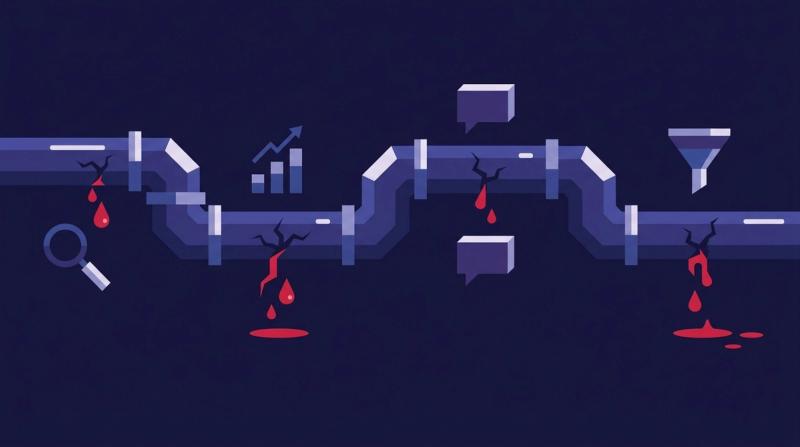
The SEO Leak Map is a four-stage model for finding where SEO loses money: Crawl, Rank, Cite and Convert, with pipeline measurement looping back to the start. Every mistake leaks at one stage. The rule is to fix the earliest leaking stage first, because a leak upstream caps every stage below it.

The SEO Leak Map: the question each stage answers
| Stage | Question | Quick test |
|---|---|---|
| Crawl | Can Google and AI bots find and read the page? | Load it with JavaScript off; check it in Search Console's URL Inspection |
| Rank | Does it beat what's already on page one? | Compare depth, links and intent match with the top 3 results |
| Cite | Do AI answers name and link your brand? | Run your top 20 buyer prompts through ChatGPT and Perplexity |
| Convert | Does the visit turn into a signup or demo? | Check demos by landing page in your CRM |
Order matters. A pricing page that Google can't render won't rank, so rewriting its copy for conversions does nothing yet. But a page that ranks and never gets cited is leaking too, because buyers now start somewhere else.
G2's 2026 buyer research found 51% of B2B software buyers now start research in an AI chatbot more often than in Google, up from 29% a year earlier. Cite sits right after Rank for a reason: the OppAlerts study of about 167,000 domains found your best Google ranking correlates at +0.148 with AI citations, so ranking problems flow straight into AI visibility.
Strategy Mistakes That Aim SEO at the Wrong Buyers
Strategy mistakes decide which searches you win. Get them wrong and even a technically perfect site fills up with visitors who'll never buy. For SaaS, the costliest ones are sorting keywords by volume and skipping the pages buyers read right before a demo. Naming pages after internal features comes a close second.
Chasing Search Volume Instead of Buyer Intent
A keyword with 5,000 searches from students is worth less than one with 50 searches from buyers comparing tools. Yet SaaS teams still sort keyword lists by volume and write from the top down. Traffic climbs. Demos don't.
“You create all this content and theoretical rankings, but no one googles those terms when they're ready to buy, so they don't find anything, and they don't convert.”
Tag every keyword by buying stage before anyone writes a word. Ranking for "what is CRM" when you sell email marketing software brings visitors who'll never convert, however good the post is. Our guide to bottom of funnel keywords shows how to sort a list by intent.
Skipping Pricing, Comparison and Integration Pages
Pricing, "[competitor] alternatives", "X vs Y" and integration pages are where buyers make up their minds, and plenty of SaaS sites have none. Our view is blunt: bottom-of-funnel pages should make up at least 40% of a SaaS content calendar. Teams that over-invest in top-of-funnel posts end up wondering why traffic doesn't convert.
These pages matter even more in AI search. Seer Interactive found comparison queries trigger an AI Overview 95.4% of the time, so if you don't have a vs page, the summary gets built from a competitor's version of the comparison.
Writing About Features Instead of Problems
Feature pages named after internal product terms, like "Smart Sync" or "Flow Builder", rank for nothing because nobody searches those words. Buyers search the job they need done: "sync Salesforce to HubSpot" or "approval workflow software". Rewrite each feature page around that job and keep your product name in a subheading.
Technical SEO Mistakes SaaS Sites Make in 2026
SaaS sites break in predictable technical ways because product engineers build them, not web teams. Marketing pages end up rendered by client-side JavaScript, and docs or app subdomains flood the index with thin URLs. Both stop Google and AI crawlers before content quality or links get a chance to count.
Letting JavaScript Rendering Hide Your Pages
Google can render JavaScript, but its own JavaScript SEO guide still calls server-side rendering or pre-rendering "a great idea" because "not all bots can run JavaScript". Vercel's crawler analysis found none of the major AI crawlers render it, Gemini aside. Cyrus Shepard's meta-analysis of 54 studies scored URL accessibility 9.5 out of 10, the highest of 23 AI citation factors.
Test it in two minutes. Load your pricing and feature pages with JavaScript turned off. If the main copy disappears, so does the page for most AI crawlers. Our technical SEO guide covers rendering checks and fixes in more depth.
Index Bloat From Docs, Tag and Programmatic Pages
SaaS sites pile up low-value URLs fast: help articles for every button, blog tag archives, changelog entries and programmatic pages with one word swapped. In our experience, thousands of near-empty URLs drag down how Google rates the whole site. Noindex tag archives and merge near-duplicate docs. Google's duplicate URL guide explains which canonical signal to use for each case.
Orphaned Product and Feature Pages
New feature and integration pages often launch with zero internal links, so Google finds them late or not at all. Link every new page from a relevant hub and at least two related posts on launch day. Redesigns cause the same problem at scale when old URLs die without 301 redirects and take their backlinks with them.
Content Mistakes: Thin AI Pages and Decay
Content mistakes come in two forms: publishing too much weak content, and ignoring the good content you already have. The first can trigger a penalty that erases years of traffic in weeks. The second is slower, but AI assistants favor fresher pages, so decay now costs citations as well as rankings.
Publishing Thin AI Content at Scale
Causal is the cautionary tale. The finance startup used generative AI to publish about 1,800 articles cloned from a competitor's sitemap, got a manual penalty, and lost 99.52% of its organic traffic, according to Ryan Law's Ahrefs study. BetterCloud lost 94.14% after most of its /academy section, full of generic how-to posts, stopped ranking around Google's November 2023 core update.
Google's spam policies call this scaled content abuse: many pages made mainly to manipulate rankings, "no matter how it's created." Its March 2024 update aimed to cut low-quality, unoriginal content in results by 40 to 45%. Use AI for research and first drafts if you like. But every published page needs something a model couldn't write alone, like your own data or a clear opinion.
Letting Good Content Decay
A post that ranked in 2023 slides as competitors refresh theirs. Ryan Law found content cited by AI assistants is 25.7% fresher than the average organic result, so stale posts now lose AI citations too. Once a quarter, pull the pages that lost the most clicks in Google Search Console and refresh the top 10 before writing anything new.
Authority and AI Search Mistakes
Authority mistakes show up as pages that are well written and indexed but stuck on page two. SaaS teams know links matter, then push link building to "after launch" and never start. In 2026 the same gap shows up in AI answers, which lean on what other sites say about you.
Treating Link Building as an Afterthought
Links still separate pages of similar quality, especially on commercial terms like "best [category] software". The two classic errors are pointing every link at the homepage and buying cheap bulk packages. Point links at the pages that make money instead: pricing, comparison, alternatives and feature pages.
Page-level links move those pages fast. SAASY LINKS' niche edit campaign for an HR tech SaaS placed 12 contextual links in 30 days at an average DR of 55, and the target page moved from position 31 to position 8 for "best HR software for startups". Our SaaS link building service focuses on exactly those revenue pages.
Ignoring Brand Mentions and AI Citations
AI assistants recommend brands that other sites talk about. A SaaS company with strong rankings but no mentions on review sites, industry blogs, podcasts or "best X" lists can get left out of ChatGPT answers for its own category, while smaller competitors with more mentions get named.
Track it every month. Run 20 to 40 buyer prompts through ChatGPT, Perplexity, Gemini and Google AI Mode, and note who gets named and which pages get cited. Our guide to brand mentions for SEO covers how to earn the mentions that change those answers.
Measurement Mistakes That Hide the Real Problem
Measurement mistakes don't break anything directly. They hide what's broken, so teams fix the wrong thing or give up before the work pays off. The two to watch are judging SEO by sessions instead of pipeline, and quitting before new pages have had time to rank.
Reporting Traffic Instead of Pipeline
Traffic is the easiest SEO number to report and the least useful. Our opinion: if a content agency can't show which posts produced pipeline, fire them. Add a "How did you hear about us?" field, tag organic first touch in your CRM, and report demos and signups by landing page every month.
Bad measurement also causes misdiagnosis. SAASY LINKS reviewed 40 client ranking drops blamed on negative SEO between 2024 and 2026. Of those, 37 traced to algorithm updates, technical errors or lost links, and 3 involved hacked pages. None came from spam links alone. A proper B2B SEO audit finds the real cause faster than a disavow file does.
Quitting After 3 Months
SEO compounds slowly, and it's getting slower. Ahrefs checked 1 million pages first seen in September 2023 and found only 1.74% reached Google's top 10 within a year, down from 5.7% in 2017. The average #1 page is 5 years old. Budgets cut at month three stop the work right before it starts paying.
Set expectations in demos or signups, and re-score priorities each quarter instead of each week. A written SEO roadmap makes that review routine, so nobody pulls the plug on work that's still compounding.
What Doesn't Work When Fixing SaaS SEO
Two popular fixes feel productive and still leave rankings flat. We see both in audits every quarter, usually right after a traffic drop sends the team hunting for a quick win it can ship that week. Skip them and put the time into the leak stages above.
Copying the top-ranking article and adding 200 words is the first. Google's helpful content guidance asks whether you're "mainly summarizing what others have to say without adding much value", and a longer copy of the same article fails that test.
Cross-posting every article to Medium and LinkedIn is the second. Duplicate content won't get you penalized, but Google picks one version to rank. If Medium's copy wins, you've handed your traffic to a domain you don't control.
How to Prioritize SaaS SEO Fixes in 2026
Prioritize by leak stage first, then by effort. Crawl fixes usually come first because they're cheap and unblock everything downstream. Content and authority fixes take months, so start them early and let them run while quicker wins land. The table scores all 12 SaaS SEO mistakes on impact and effort.
SaaS SEO fix priority: impact vs effort
| Fix | Leak stage | Impact | Effort | When |
|---|---|---|---|---|
| Server-side render marketing pages | Crawl | High | Medium (dev sprint) | Month 1 |
| Link orphaned product pages from hubs | Crawl | Medium | Low | Week 1 |
| Noindex or merge bloat pages | Crawl | Medium | Low to medium | Month 1 |
| Tag keywords by buying stage | Convert | High | Low | Week 1 |
| Build pricing, vs, alternatives and integration pages | Convert | High | Medium | Quarter 1 |
| Rewrite feature pages around problems | Rank | Medium | Low | Month 1 |
| Cut or rewrite thin AI pages | Rank | High | Medium | Quarter 1 |
| Monthly links to revenue pages | Rank | High | Ongoing | Start in month 1 |
| Refresh top 10 decaying posts | Cite | Medium | Medium | Every quarter |
| Earn mentions, track AI prompts | Cite | Medium | Ongoing | Start in month 1 |
| Report demos by landing page | Measure | High | Low | Week 1 |
| Plan and review SEO by quarter | Measure | Medium | Low | Every quarter |
To turn the table into dated tasks, work through our SaaS SEO checklist. If you'd rather hand the whole thing off, our SaaS SEO services start with this kind of leak audit.
Frequently Asked Questions
What are the most common SaaS SEO mistakes?
The most common are choosing keywords by volume instead of intent, skipping pricing and comparison pages, hiding pages behind JavaScript and publishing thin AI content at scale. Reporting traffic instead of pipeline hides all of them.
What is the biggest SEO mistake SaaS companies make?
Targeting searches that buyers don't make. It produces traffic that never turns into demos, which gets SEO budgets cut even when rankings look healthy.
What are common SEO mistakes to avoid in 2026?
Avoid publishing unedited AI content at scale, blocking AI crawlers, skipping comparison pages and letting old posts decay. Each one costs rankings and AI citations at the same time.
Can AI-generated content hurt SaaS SEO?
Yes, when it's published at scale without original value. Google treats that as scaled content abuse, and Causal lost 99.52% of its organic traffic after publishing about 1,800 AI articles.
How do I know if my SaaS site has technical SEO problems?
Load key pages with JavaScript off and check them in Search Console's URL Inspection tool. Missing copy and thousands of indexed URLs with no clicks both point to technical leaks.
How long do SaaS SEO fixes take to show results?
Crawl fixes can show results in weeks once Google recrawls the pages. New content and link building usually need several months, so plan and review them by quarter.
Are enterprise SEO mistakes different from startup ones?
Mostly in scale. Enterprise sites suffer more from index bloat and redirect chains, while startups more often skip bottom-of-funnel pages and quit too early.

Written by
Co-founder & CEO of SAASY LINKS, the B2B SaaS link building and AI visibility agency. 10+ years in SEO and growth marketing for SaaS brands. Mentor at 500 Startups and Techstars. Runs the Backlink Masterminds community for link builders.
Get Your SaaS Ranked on Google & Cited by AI
Senior-led AI SEO combining strategy, content, editorial links, and AI optimization in 90-day sprints. Built exclusively for B2B SaaS.
Book a Free Consultation CallBuilt exclusively for SaaS.


